My Home & Solar Solutions Clean Energy Report
Clean Energy News
Transparent Reporting for a Sustainable Future
Latest News
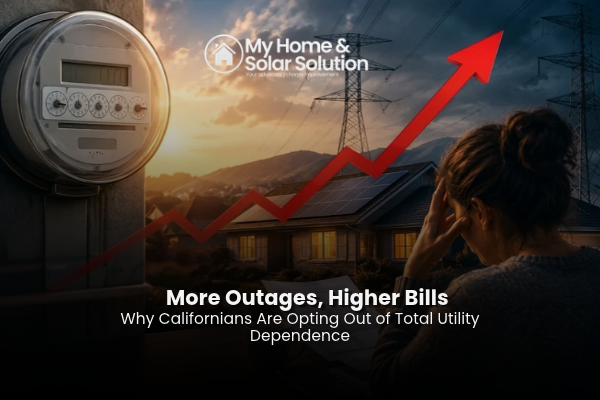
More Outages, Higher Bills Why Californians Are Opting Out of Total Utility Dependence
More Outages, Higher Bills: Why Californians Are Opting Out of Total Utility Dependence
The lights go out on a windy October night, and your bill still arrives on time. For a growing number of California homeowners, that is no longer a rare annoyance. It is the new normal. Power is getting less reliable and more expensive at the same time. Here is what the numbers show, and how your neighbors are taking back control.
The Outage Problem Is Real, and It Is Getting Worse
Last month, Southern California Edison cut power to nearly 70,000 customers across Los Angeles and Ventura counties during a Santa Ana wind event. As of the morning of October 16, 2026, about 34,946 customers in LA County and 34,800 in Ventura County were in the dark. That was not a one-off. SCE's Public Safety Power Shutoffs (PSPS) have grown sharply in just a few years.
About 34,000 SCE customers were affected by safety shutoffs in 2023. In 2024 it was about 137,000. In 2025, Edison cut power to 534,000 customers, according to its filings with state regulators. That was more than ever before and almost four times the year before. SCE's own 2026 PSPS Action Plan counts 8 shutoff events in 2023, 20 in 2024 and 14 in 2025, with more customers affected per event. After the January 2025 Eaton fire, SCE lowered the wind speeds that trigger shutoffs and extended them to tens of thousands more customers. Regulators noticed. In November 2025, CPUC President Alice Reynolds wrote to Edison expressing "serious concern" about leaving more customers in the dark. Edison had cut power to a record number of residential customers in January 2025, and more than 10,000 critical facilities, including hospitals, were de-energized. The longest blackout lasted 15 days. It is not just SCE. In a separate event on October 13, 2026, PG&E warned about 70,000 of its customers across 29 counties that their power could be shut off during strong winds.
Outage Minutes Have More Than Quadrupled Utilities track reliability with a measure called SAIDI, the average number of minutes each customer goes without power in a year.
SCE's 2025 reliability report shows just how much that number has moved:
SCE outage minutes per customer (SAIDI, all events)
2021
179.79
2022
131.13
2023
115.90
2024
158.30
2025
545.01
Data from SCE's 2025 Annual Electric Reliability Report, Table 3 (unplanned outages, including Major Event Days). Figures are system averages; your home's experience may differ. For informational purposes only. That is roughly nine hours without power for the average SCE customer in 2025, up from about two hours in 2023. SCE says the jump was driven mostly by 21 major event days in 2025. Thirteen of those, all in January, were tied fully or partly to PSPS.
For context, the U.S. Energy Information Administration reports that American customers averaged about 11 hours of interruptions in 2024, mostly from hurricanes. In SCE territory, a big share of the lost hours now comes from planned wildfire shutoffs. You can follow active shutoffs and outage trends on our Outage Watch PSPS tracker.
You Are Paying More for It
The second half of the double hit is the bill. We covered this in depth recently, so here is the short version. According to the CPUC, average rates rose about 43% at SCE, 45% at PG&E and 47% at SDG&E between January 2021 and spring 2026. If rates had tracked inflation, the increase would have been about 23%. The outlook is not much better. In reports issued October 28, 2026, the CPUC projected residential electric rates will keep rising faster than inflation through 2029, at about 4% to 6% a year, compared with an assumed 3.2% inflation rate. See what is changing on your bill in our 2026 California utility rate report.
What "Opting Out" Really Means
When we say Californians are opting out, we do not mean they are cutting the cord. Homes on SCE's Net-Billing program, for example, stay connected to the grid by design. Opting out means reducing how much you depend on the utility. You make more of your own power, store some for later, and keep critical circuits running when the grid goes down.
Here is what that shift looks like in numbers.
Rooftop solar is mainstream. PG&E alone announced in June 2026 that more than 1 million customers have solar connected to its grid, which it says is more than any other U.S. utility. Batteries are now the norm, not the add-on. According to the CPUC, nearly 70% of Net-Billing customers paired a battery with their solar by the end of 2024. Under the old net-metering program, only about 10% did, according to 2024 Lawrence Berkeley National Laboratory data. Home batteries are adding up. The California Energy Commission reported in August 2026 that more than 300,000 smaller battery systems at homes, schools, farms and businesses now provide about 3,000 megawatts of capacity statewide. More families are choosing not to own the equipment. The 30% federal homeowner tax credit for purchased systems expired December 31, 2025. Systems owned by a solar company may still qualify for a separate federal credit under set deadlines. Analysts at Jefferies projected third-party-owned adoption would grow 25% in 2026. Tax rules vary, so confirm your own situation with a tax professional. Whole communities are choosing their power source. California's 25 community choice aggregators (CCAs) now serve more than 15 million customers, according to the California Community Choice Association. CCAs buy the power, but the utility still delivers it and maintains the lines, so CCA customers still face the same outages. That last point matters. Changing who buys your electricity can change your rate. It does not keep your lights on during a shutoff. Only power stored at your home can do that.
Why Solar + Battery Answers Both Problems
Rising rates and rising outages hit you in two different places: your wallet and your daily life. Solar and a battery work on both. On cost, solar lets you produce a big share of your own electricity instead of buying it at rates that keep climbing. A battery stores midday solar for the evening, when power is most expensive under time-of-use plans. On reliability, a properly configured battery can keep your fridge, lights, Wi-Fi, medical devices and other essentials running when SCE or PG&E de-energizes your circuit. Instead of watching the forecast and counting hours, you keep living your life. That is why the CPUC notes that batteries paired with solar help reduce the need to run fossil gas power plants when demand peaks after sunset. What is good for your home is also good for the grid.
A Simpler Way to Take Control
At My Home & Solar Solution, we help California homeowners get solar and battery backup without buying, leasing, or financing equipment. Our advisors look at your actual utility bill, your outage history and your rate plan to see if your home is a fit. Homeowners who qualify may cut their utility costs by up to 40%, depending on usage, rate plan and system design. Through a power purchase agreement, you simply pay for the power the system produces. Learn more at My Home & Solar Solution. The grid is not going away, and neither are wildfire season or rate cases. What you can change is how exposed your home is to both.
Text "schedule" to 805.870.8415 for a complimentary advisor call to see if your utility bill qualifies.

MEET THE Team
My Home & Solar Solution is a virtual home‑energy brokerage committed to serving homeowners at the highest level as they navigate every stage of homeownership. Our mission is to build true financial literacy around the home—helping families understand their utility bills, evaluate financing options, and make smart long‑term decisions about their property. We design and broker rooftop solar, battery storage, roofing, and other energy‑efficient upgrades so homes become more resilient, more modern, and less expensive to operate. At the same time, we translate complex climate policy and utility politics into clear, practical insights, so homeowners can see how decisions made in Washington, Sacramento, and their local utility boardroom actually affect life—and costs—at home.
What We Cover...

Technological Innovations
Solar technology is advancing at an unprecedented pace. Our news page features updates on groundbreaking developments, including:
High-efficiency panels: Learn about the latest solar panels, including advancements in materials like perovskite and bifacial designs.
Energy storage: Discover innovations in battery technologies that enhance the reliability and scalability of solar systems.
Smart grids: Stay informed about how solar integrates with smart grid systems to optimize energy distribution.

Market Trends and Analysis
Understanding market dynamics is crucial for anyone involved in solar energy. Our articles delve into:
Solar adoption rates: Explore data on how solar installations are growing across residential, commercial, and industrial sectors.
Pricing trends: Get insights into the costs of solar panels, inverters, batteries, and installation services.
Investment opportunities: Stay ahead with information about renewable energy stocks, tax credits, and financial incentives.

Policy and Legislation
Solar energy thrives on supportive policies. Our coverage includes:
Federal and state incentives: Learn about tax credits, rebates, and grants available to solar adopters.
Regulations: Understand net metering policies, permitting processes, and compliance requirements.
Global policies: Discover how international agreements and policies impact the U.S. solar industry.

Environmental Impact
Renewable energy and smart home upgrades are essential in reducing carbon footprints and promoting sustainability. Our content highlights:
Carbon savings: Understand the environmental benefits of switching to renewable energy and energy-efficient technologies.
Sustainability practices: Explore how smart homes, energy storage, and eco-friendly upgrades contribute to broader sustainability goals.
Real World Impact: Discover case studies of successful projects that showcase how renewable energy and smart innovations benefit communities and ecosystems..

Solar Success Stories
Real-world applications of solar energy inspire and inform. We feature:
Residential installations: See how homeowners are transforming their energy usage with solar panels.
Business case studies: Learn about companies leading the charge in renewable energy adoption.
Community projects: Discover how solar energy is empowering underserved regions and creating jobs.

Challenges and Solutions
While solar energy offers numerous benefits, challenges remain. We address issues like:
Grid reliability: Explore how solar interacts with aging grid infrastructure.
Material sourcing: Understand the sustainability concerns related to raw materials for solar panels and batteries.
End-of-life management: Learn about recycling and disposal solutions for solar equipment.
Our Vision For The Future
At My Home & Solar Solutions, our vision extends beyond providing news.
We aim to:
Advocate for policy changes: Support initiatives that make renewable energy and home improvement upgrades more accessible and affordable.
Drive innovation: Partner with industry leaders to bring the latest technologies to market.
Promote sustainability: Champion practices that prioritize environmental health and resource conservation.
By aligning with these goals, we strive to create a platform that not only informs but also inspires action.
Why Choose My Home & Solar Solution for Your Home Improvement News?
We take pride in delivering:
Expertise: With over a decade of experience in the solar industry, we bring unparalleled knowledge to our reporting.
Accuracy: Our content is meticulously researched and verified to ensure reliability.
Relevance: We focus on topics that matter most to our audience, from homeowners to industry professionals.
Our commitment to quality has earned us a reputation as the authoritative source for solar news in the U.S. By choosing My Home & Solar Solution, you are choosing a partner dedicated to your energy independence and environmental stewardship
Facebook
Instagram
Youtube