My Home & Solar Solutions Clean Energy Report
Clean Energy News
Transparent Reporting for a Sustainable Future
Latest News
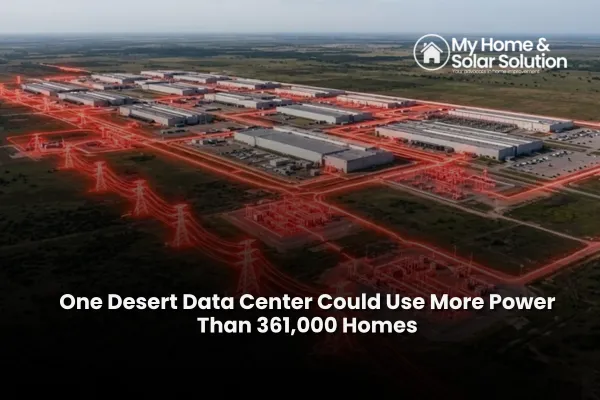
One Desert Data Center Could Use More Power Than 361,000 Homes
One Desert Data Center Could Use More Power Than 361,000 Homes
In California's Imperial Valley, a single proposed project has become a symbol of how fast data centers are growing. Developer Sebastian Rucci has proposed a nearly one-million-square-foot data center near the City of Imperial, rated at about 330 megawatts. Supporters say it would be the largest data center in California. At full power, 330 megawatts running year-round works out to about 2.9 billion kilowatt-hours. Using an average of 8,000 kilowatt-hours per home, that is as much electricity as roughly 361,000 California homes use in a year. That is more homes than exist in all of Imperial County.
The county hit pause
The project has faced months of community opposition. On June 16, 2026, the Imperial County Board of Supervisors voted unanimously to pause pending and future data center projects under an urgency ordinance. A 19-member advisory committee is now developing zoning and building rules for data centers, with recommendations expected by January 2027. Residents raised concerns about energy and water consumption, environmental and public health impacts, and the project moving forward without full state environmental review. The Sierra Club has challenged the project in court, and the developer has said he plans to sue over the moratorium.
What a project this size means for the grid
A data center does not sleep. Unlike a home, which uses more power in the evening and less overnight, a data center runs around the clock, often at 80 percent of its capacity or more. That includes the hot late afternoons and evenings when California's grid is already under the most strain. Serving that kind of load requires new transmission, new substations and new generation. Someone has to pay for that infrastructure, and state consumer advocates have warned that ratepayers could be left covering costs if large projects stall or fail.
The question for homeowners
Whether or not this particular project is ever built, it shows where electricity demand is heading. Imperial is one of many communities being asked to host massive new loads. When demand grows faster than the grid, the hours of highest demand become the most expensive hours to buy power. That puts every homeowner on one side of the meter. You can keep buying all of your electricity from the grid and absorb whatever rate increases come next. Or you can produce your own power, store it, and send extra energy back to the grid for compensation.
Producing your own power without buying equipment
Many homeowners assume solar and batteries require a large purchase or a long-term loan. That is no longer the only path. Qualifying California homeowners can get solar and battery storage through third-party ownership programs, without buying or financing equipment. The system serves the home first, the battery covers expensive evening hours, and extra power sent to the grid earns bill credits. With Governor Newsom's signature on SB 913, the state is now working on a method to value home batteries that send power to the grid during periods of high demand. As data centers push demand higher, homes that can supply power are positioned on the right side of that equation.
The takeaway
A single data center can use as much electricity as hundreds of thousands of homes. Homeowners cannot control what gets built in the desert, but they can control where their own power comes from and how exposed they are to rising rates. Depending on the home and program, savings can reach up to 40 percent compared with utility rates.
To find out if your home qualifies for a TPO solar and battery program, visit myhomesolution.org/california_public_utility_commissions
MEET THE Team
My Home & Solar Solution is a virtual home‑energy brokerage committed to serving homeowners at the highest level as they navigate every stage of homeownership. Our mission is to build true financial literacy around the home—helping families understand their utility bills, evaluate financing options, and make smart long‑term decisions about their property. We design and broker rooftop solar, battery storage, roofing, and other energy‑efficient upgrades so homes become more resilient, more modern, and less expensive to operate. At the same time, we translate complex climate policy and utility politics into clear, practical insights, so homeowners can see how decisions made in Washington, Sacramento, and their local utility boardroom actually affect life—and costs—at home.
What We Cover...

Technological Innovations
Solar technology is advancing at an unprecedented pace. Our news page features updates on groundbreaking developments, including:
High-efficiency panels: Learn about the latest solar panels, including advancements in materials like perovskite and bifacial designs.
Energy storage: Discover innovations in battery technologies that enhance the reliability and scalability of solar systems.
Smart grids: Stay informed about how solar integrates with smart grid systems to optimize energy distribution.

Market Trends and Analysis
Understanding market dynamics is crucial for anyone involved in solar energy. Our articles delve into:
Solar adoption rates: Explore data on how solar installations are growing across residential, commercial, and industrial sectors.
Pricing trends: Get insights into the costs of solar panels, inverters, batteries, and installation services.
Investment opportunities: Stay ahead with information about renewable energy stocks, tax credits, and financial incentives.

Policy and Legislation
Solar energy thrives on supportive policies. Our coverage includes:
Federal and state incentives: Learn about tax credits, rebates, and grants available to solar adopters.
Regulations: Understand net metering policies, permitting processes, and compliance requirements.
Global policies: Discover how international agreements and policies impact the U.S. solar industry.

Environmental Impact
Renewable energy and smart home upgrades are essential in reducing carbon footprints and promoting sustainability. Our content highlights:
Carbon savings: Understand the environmental benefits of switching to renewable energy and energy-efficient technologies.
Sustainability practices: Explore how smart homes, energy storage, and eco-friendly upgrades contribute to broader sustainability goals.
Real World Impact: Discover case studies of successful projects that showcase how renewable energy and smart innovations benefit communities and ecosystems..

Solar Success Stories
Real-world applications of solar energy inspire and inform. We feature:
Residential installations: See how homeowners are transforming their energy usage with solar panels.
Business case studies: Learn about companies leading the charge in renewable energy adoption.
Community projects: Discover how solar energy is empowering underserved regions and creating jobs.

Challenges and Solutions
While solar energy offers numerous benefits, challenges remain. We address issues like:
Grid reliability: Explore how solar interacts with aging grid infrastructure.
Material sourcing: Understand the sustainability concerns related to raw materials for solar panels and batteries.
End-of-life management: Learn about recycling and disposal solutions for solar equipment.
Our Vision For The Future
At My Home & Solar Solutions, our vision extends beyond providing news.
We aim to:
Advocate for policy changes: Support initiatives that make renewable energy and home improvement upgrades more accessible and affordable.
Drive innovation: Partner with industry leaders to bring the latest technologies to market.
Promote sustainability: Champion practices that prioritize environmental health and resource conservation.
By aligning with these goals, we strive to create a platform that not only informs but also inspires action.
Why Choose My Home & Solar Solution for Your Home Improvement News?
We take pride in delivering:
Expertise: With over a decade of experience in the solar industry, we bring unparalleled knowledge to our reporting.
Accuracy: Our content is meticulously researched and verified to ensure reliability.
Relevance: We focus on topics that matter most to our audience, from homeowners to industry professionals.
Our commitment to quality has earned us a reputation as the authoritative source for solar news in the U.S. By choosing My Home & Solar Solution, you are choosing a partner dedicated to your energy independence and environmental stewardship
Facebook
Instagram
Youtube