My Home & Solar Solutions Clean Energy Report
Clean Energy News
Transparent Reporting for a Sustainable Future
Latest News
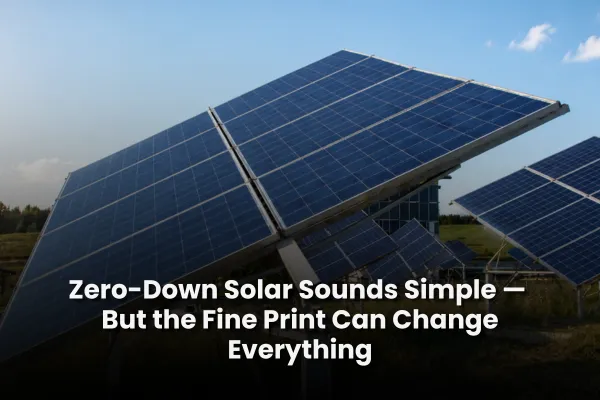
Zero-Down Solar Sounds Simple — But the Fine Print Can Change Everything
Zero-Down Solar Sounds Simple — But the Fine Print Can Change Everything
"Zero down" is one of the most powerful phrases in solar marketing. And for good reason — for most California homeowners, the prospect of going solar with no upfront cost is genuinely appealing. Why wait until you've saved $20,000 when you can start saving on your electric bill today?
The pitch is real. Zero-down solar is real. But "zero down" is not the same as "no strings attached." Depending on the structure of the agreement you sign, the fine print can mean very different things for your finances, your home's resale value, and your flexibility over the next 20–25 years. Here's what every California homeowner should understand about zero-down solar before signing anything.
The Three Structures That Offer Zero Down
There are three common ways to go solar with no upfront payment. They look similar at the point of sale. They are not.
Zero-Down Solar Loan: You borrow the full cost of the system, typically from a third-party solar lending company, and repay it over 10–25 years. No money down, but you're taking on debt. The interest rate, loan term, and — critically — the dealer fee baked into the system price determine your total cost of ownership. Many solar loans include origination fees of 10–30% of the system cost, disguised as a higher installed price, that add thousands of dollars to what you're actually paying.
Solar Lease: You pay a fixed monthly lease payment for the use of the equipment. You don't own the system. You don't receive the federal tax credit. If you sell your home, the lease must be transferred to the buyer — and not all buyers are willing to assume a 15-year lease obligation. Leases often include annual payment escalators of 1–3% per year that erode your savings over time.
Third-Party Ownership (TPO) / Power Purchase Agreement: You pay for the energy the system produces, not for the equipment itself. The program partner owns and maintains the system. Your monthly payment is tied to energy consumption, not a fixed equipment fee. TPO programs are specifically designed to comply with CPUC net billing rules and can be structured to provide immediate, measurable bill savings. This is the structure My Home & Solar Solutions works with.
What to Look for in the Fine Print
Regardless of which zero-down structure you're evaluating, there are specific contract terms that materially affect your financial outcome:
Escalator Clauses: Does your monthly payment stay flat, or does it increase each year? A 2% annual escalator sounds modest, but over 20 years it means you're paying 48% more at the end of the term than at the beginning. Always ask for the year-20 payment and compare it to your projected utility rate at that time.
What Happens at Transfer or Sale: If you sell your home before the contract ends, who is responsible for the agreement? Some structures allow the agreement to be transferred to the buyer at no cost and can actually enhance home value by offering below-market energy rates. Others require payoff at closing, which reduces your net proceeds. Know which one you're signing before you sign.
Dealer Fees in Loan Products: Ask specifically: "What is the dealer fee on this loan, and how is it reflected in the installed system price?" If the answer is evasive or you're told there is no dealer fee, request an itemized breakdown. A $30,000 system with a 20% dealer fee has a true installed cost of $25,000 — but you're paying interest on $30,000.
Who Maintains the Equipment: Under a zero-down loan, you own the system — which means you're responsible for maintenance beyond the manufacturer warranty. Under TPO, the program partner owns the equipment and is contractually obligated to maintain it. This difference becomes significant at year 10 when inverters commonly need replacement.
The Value of Comparing Structures Side by Side
The single biggest mistake California homeowners make when evaluating zero-down solar is comparing offers from different structures without adjusting for what's included. A zero-down loan offer and a TPO offer both claim to provide solar at no upfront cost, but they're entirely different commitments. The loan gives you ownership and maximum long-term financial return — if the system performs as promised, if the installer is still in business when warranty issues arise, and if you can manage the debt service. The TPO eliminates all of those risks and complexities in exchange for a slightly less optimal long-term financial position. Neither is universally better. The right structure depends on your situation, your timeline, your risk tolerance, and whether you qualify for specific programs.
Red Flags to Watch For:
In the California solar market, several practices warrant caution:
Pressure to sign same-day: A reputable program partner will give you time to review contracts and consult an advisor. High-pressure tactics are a sign that the company doesn't want you to read the fine print. Vague answers about dealer fees or escalators: If a sales representative can't or won't clearly explain what you'll pay in year 10 and year 20, that's a problem. Guarantees of specific bill amounts: Solar production varies with weather, system performance, and your usage. No honest company guarantees a specific dollar savings amount.
No mention of NEM 3.0 and batteries: A solar company that isn't discussing how their system is designed to perform under California's current net billing rules isn't giving you the full picture.
What Due Diligence Looks Like
Before signing any solar agreement in California, take these steps:
Get at least two or three proposals from different companies using different structures. Ask each company to provide a 25-year cash flow projection showing your total payments and estimated savings year by year. Run the proposal by someone who understands solar contracts — or ask My Home & Solar Solutions to review a competitor's offer for free.My Home & Solar Solutions works exclusively with TPO programs that are transparent, California-compliant, and designed to deliver real savings from day one. We'll tell you clearly what your monthly payment is, whether it escalates, what happens when you sell your home, and exactly who is responsible for maintaining the equipment on your roof.
Visit https://myhomesolution.org/california_public_utility_commissions to schedule a consultation. Zero-down is a great starting point. Make sure what you're signing lives up to the headline.
MEET THE Team
My Home & Solar Solution is a virtual home‑energy brokerage committed to serving homeowners at the highest level as they navigate every stage of homeownership. Our mission is to build true financial literacy around the home—helping families understand their utility bills, evaluate financing options, and make smart long‑term decisions about their property. We design and broker rooftop solar, battery storage, roofing, and other energy‑efficient upgrades so homes become more resilient, more modern, and less expensive to operate. At the same time, we translate complex climate policy and utility politics into clear, practical insights, so homeowners can see how decisions made in Washington, Sacramento, and their local utility boardroom actually affect life—and costs—at home.
What We Cover...

Technological Innovations
Solar technology is advancing at an unprecedented pace. Our news page features updates on groundbreaking developments, including:
High-efficiency panels: Learn about the latest solar panels, including advancements in materials like perovskite and bifacial designs.
Energy storage: Discover innovations in battery technologies that enhance the reliability and scalability of solar systems.
Smart grids: Stay informed about how solar integrates with smart grid systems to optimize energy distribution.

Market Trends and Analysis
Understanding market dynamics is crucial for anyone involved in solar energy. Our articles delve into:
Solar adoption rates: Explore data on how solar installations are growing across residential, commercial, and industrial sectors.
Pricing trends: Get insights into the costs of solar panels, inverters, batteries, and installation services.
Investment opportunities: Stay ahead with information about renewable energy stocks, tax credits, and financial incentives.

Policy and Legislation
Solar energy thrives on supportive policies. Our coverage includes:
Federal and state incentives: Learn about tax credits, rebates, and grants available to solar adopters.
Regulations: Understand net metering policies, permitting processes, and compliance requirements.
Global policies: Discover how international agreements and policies impact the U.S. solar industry.

Environmental Impact
Renewable energy and smart home upgrades are essential in reducing carbon footprints and promoting sustainability. Our content highlights:
Carbon savings: Understand the environmental benefits of switching to renewable energy and energy-efficient technologies.
Sustainability practices: Explore how smart homes, energy storage, and eco-friendly upgrades contribute to broader sustainability goals.
Real World Impact: Discover case studies of successful projects that showcase how renewable energy and smart innovations benefit communities and ecosystems..

Solar Success Stories
Real-world applications of solar energy inspire and inform. We feature:
Residential installations: See how homeowners are transforming their energy usage with solar panels.
Business case studies: Learn about companies leading the charge in renewable energy adoption.
Community projects: Discover how solar energy is empowering underserved regions and creating jobs.

Challenges and Solutions
While solar energy offers numerous benefits, challenges remain. We address issues like:
Grid reliability: Explore how solar interacts with aging grid infrastructure.
Material sourcing: Understand the sustainability concerns related to raw materials for solar panels and batteries.
End-of-life management: Learn about recycling and disposal solutions for solar equipment.
Our Vision For The Future
At My Home & Solar Solutions, our vision extends beyond providing news.
We aim to:
Advocate for policy changes: Support initiatives that make renewable energy and home improvement upgrades more accessible and affordable.
Drive innovation: Partner with industry leaders to bring the latest technologies to market.
Promote sustainability: Champion practices that prioritize environmental health and resource conservation.
By aligning with these goals, we strive to create a platform that not only informs but also inspires action.
Why Choose My Home & Solar Solution for Your Home Improvement News?
We take pride in delivering:
Expertise: With over a decade of experience in the solar industry, we bring unparalleled knowledge to our reporting.
Accuracy: Our content is meticulously researched and verified to ensure reliability.
Relevance: We focus on topics that matter most to our audience, from homeowners to industry professionals.
Our commitment to quality has earned us a reputation as the authoritative source for solar news in the U.S. By choosing My Home & Solar Solution, you are choosing a partner dedicated to your energy independence and environmental stewardship
Facebook
Instagram
Youtube