My Home & Solar Solutions Clean Energy Report
Clean Energy News
Transparent Reporting for a Sustainable Future
Latest News
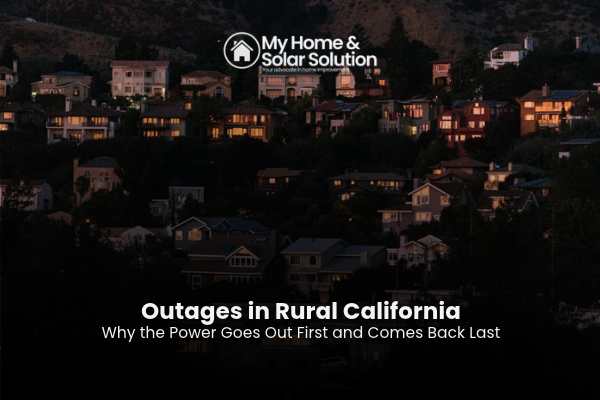
Outages in Rural California Why the Power Goes Out First and Comes Back Last
Outages in Rural California
Why the Power Goes Out First and Comes Back Last
The fridge goes quiet, the well pump stops, and there's no warning. If you live up a canyon or out in the foothills, you already know the routine, and you know your bill keeps arriving whether the lights work or not. A 2025 investigation by High Country News and Type Investigations found that for rural Californians, unreliable power has become normal. The utilities' own reliability reports back that up. Here's what's going on, and what you can do about it.
The Outages Nobody Warns You About
Most people know about Public Safety Power Shutoffs (PSPS), the planned shutoffs utilities call ahead of high winds. In PG&E territory, though, the bigger day-to-day problem has been something else: "fast-trip" outages. PG&E calls these Enhanced Powerline Safety Settings (EPSS). On fire-prone lines, equipment is set to cut power in a fraction of a second when something touches the line, like a branch or an animal. That helps stop sparks before they start a fire. It also means the power goes out instantly, with no notice.
The 2025 investigation (published November 2025) analyzed PG&E outage data from 2022 through July 2025 and found:
Fast-trip outages hit a yearly high of 2,869 in 2024. Nearly one million customers lost power to fast-trip in 2024, many more than once. Rural communities saw about 600% more fast-trip outages than urban and suburban areas. On average, rural outages lasted 5.06 hours, compared with 3.72 hours in cities and suburbs. The safety tradeoff is real. In its 2025 wildfire plan update (April 2026), PG&E reported that EPSS and related settings have kept a 69 percent reduction in the rate of larger ignitions on protected lines compared with before the program started. Fewer fires matters a lot to people who live in the trees. It just doesn't keep your refrigerator cold.
What the Reliability Reports Show
Every year, California's big utilities file reliability reports with the California Public Utilities Commission (CPUC). Two numbers matter most. SAIDI is the total minutes a typical customer goes without power in a year. CAIDI is how long an average outage lasts. Southern California Edison. In its 2025 report (filed June 30, 2026), SCE's SAIDI was 545 minutes once major events are included, more than triple the 158 minutes of 2024. Its average outage lasted about 392 minutes, or roughly 6.5 hours. Of the 21 major event days in 2025, 15 fell in January, and SCE's report ties most of those to PSPS. Even with major events left out, SCE says outage minutes rose because of "more sensitive protection settings during fire weather conditions" and broader shutoff criteria. PG&E. In its 2024 report (filed July 2025), PG&E said EPSS and related settings "contributed 58.0 customer-minutes" to its system SAIDI. That works out to about a quarter of the 226.7 minutes a typical customer lost in normal (non-major-event) conditions. Those numbers are averages across millions of customers. Because these settings are used on fire-prone lines, rural and hillside homes on those circuits can carry a much bigger share.
Why Restoration Takes Longer in the Hills
After a PSPS, crews have to inspect the lines before turning power back on. Long rural lines take longer to patrol, and they often run through rough terrain. Take PG&E's September 12, 2026 PSPS. According to its report to regulators, it cut power to 12,068 customers in 10 counties, including 598 Medical Baseline customers. Inspections found damage, including a broken conductor in Plumas County. PG&E reported that it restored everyone within 24 hours of the weather all-clear. That sounds quick, but the clock starts only after the wind dies down, and the outage itself can run much longer. SCE's June 2026 PSPS newsletter warns that events can last more than 24 hours and this year "could occur earlier, last longer and be more extensive." SCE says about a quarter of its service area is in high fire risk areas. For homes on a well, an outage also means no running water. The 2025 investigation noted that thousands of well-water users lose water whenever the power goes down.
Are You in a High Fire-Threat District?
The CPUC maps the state's High Fire-Threat Districts (HFTD). Tier 2 means elevated risk, and Tier 3 means extreme risk. If your home is in Tier 2 or 3, you're more likely to face PSPS events and sensitive line settings. Your tier also controls which utility rebates and battery incentives you can get. PG&E's Wildfire Safety Progress Map tells you if an address qualifies for its programs. You can also follow active shutoffs in real time with our Outage Watch PSPS tracker.
Your Backup Options, Compared
Portable power stations can keep phones, a router, lights and maybe a CPAP running for a while. They're quiet and need no fuel, but they can't power a well pump or a whole home for long. Generators handle bigger loads, like a fridge or pump, for as long as you have fuel. The catch is the fuel. You have to store it, refill it, and run the generator outdoors because of carbon monoxide risk. The 2025 investigation described residents spending thousands of dollars on generators.
Utility rebates help a little. Each one has its own rules and runs on its own timeline:
PG&E: up to $300 for a qualifying generator or battery, plus up to $200 more for CARE or FERA customers. You must be in an HFTD Tier 2 or 3 area, a High Fire Risk Area, or on an EPSS circuit. The program runs through December 31, 2026.
SCE: $200 for qualifying portable power stations and up to $800 for qualifying portable generators, for customers in high fire risk areas (June 2026 newsletter). Medical Baseline customers in those areas can get a backup battery through SCE's Critical Care Backup Battery program.
SDG&E: $300 off generators and $150 off portable power stations in 2026, with more for CARE or FERA customers. You must be in HFTD Tier 2 or 3 and have had at least one PSPS.
State battery incentives. The Self-Generation Incentive Program's Equity Resiliency budget can cover much of a home battery's cost for households that meet two tests. The first is location or outage history, such as living in Tier 2 or 3 or having had two or more PSPS events. The second is a need-based test, such as being on Medical Baseline or relying on an electric well pump with a qualifying low income. Funding levels change, so check current availability.
Where Solar + Battery Fits
Solar panels alone won't save you in an outage. Grid-tied systems shut off when the grid goes down so they don't send power back onto lines where crews are working, as CapRadio explained in a 2019 report. Adding a home battery changes that. The battery stores energy and powers the circuits you choose, like the fridge, the well pump, lights and medical devices. A system set up for backup switches over automatically, so a fast-trip outage that hits in seconds doesn't wait for you to drag out a generator. During a multi-day PSPS, the panels can recharge the battery every sunny day. No fuel runs. Be realistic about what it covers. A battery is sized for your essential loads, and stretching through several cloudy days or running central air needs a bigger system or some conservation. Even so, for many rural homes it's the most practical way to keep water and refrigeration going without a gas can. Solar + battery also helps on the other half of the problem, which is cost. The 2025 investigation reported that residential rates rose more than 100% over the past decade. Our 2026 California utility rate report breaks down what's changing this year.
My Home & Solar Solution helps qualifying California homeowners get solar + battery without buying, leasing, or financing equipment. Through a power purchase agreement, you pay for the power the system produces, with savings of up to 40% depending on your home and usage. See what neighbors say in our customer reviews.
If your power goes out first and comes back last, you don't have to just wait it out.
Text "schedule" to 805.870.8415 for a complimentary advisor call to see if your utility bill qualifies.
High Country News and Type Investigations, "For rural Californians, unreliable power has become the norm," Emma Foehringer Merchant and Maria Parazo Rose, published Nov. 3, 2025, updated Nov. 21, 2025 (2025). https://www.hcn.org/issues/57-11/for-rural-californians-unreliable-power-has-become-the-norm/
Southern California Edison, Annual Electric Reliability Report 2025, filed June 30, 2026. https://www.sce.com/sites/default/files/outage-safety/Annual%20Electric%20Reliability%20Report%202025.pdf
SCE, 2026 PSPS Newsletter for High Fire Risk Areas, June 2026. https://www.sce.com/sites/default/files/outage-safety/PSPS/G26-000%202026%20SCE%20PSPS%20Newsletter%20HFRA_060326_WCAG.pdf
PG&E, Generator and Battery Rebate Program (accessed Nov. 9, 2026). https://www.pge.com/en/outages-and-safety/outage-preparedness-and-support/general-outage-resources/generator-and-battery-rebate-program.html
SDG&E, Generator Assistance Program, 2026 (accessed Nov. 9, 2026). https://www.sdge.com/generator-assistance-program

MEET THE Team
My Home & Solar Solution is a virtual home‑energy brokerage committed to serving homeowners at the highest level as they navigate every stage of homeownership. Our mission is to build true financial literacy around the home—helping families understand their utility bills, evaluate financing options, and make smart long‑term decisions about their property. We design and broker rooftop solar, battery storage, roofing, and other energy‑efficient upgrades so homes become more resilient, more modern, and less expensive to operate. At the same time, we translate complex climate policy and utility politics into clear, practical insights, so homeowners can see how decisions made in Washington, Sacramento, and their local utility boardroom actually affect life—and costs—at home.
What We Cover...

Technological Innovations
Solar technology is advancing at an unprecedented pace. Our news page features updates on groundbreaking developments, including:
High-efficiency panels: Learn about the latest solar panels, including advancements in materials like perovskite and bifacial designs.
Energy storage: Discover innovations in battery technologies that enhance the reliability and scalability of solar systems.
Smart grids: Stay informed about how solar integrates with smart grid systems to optimize energy distribution.

Market Trends and Analysis
Understanding market dynamics is crucial for anyone involved in solar energy. Our articles delve into:
Solar adoption rates: Explore data on how solar installations are growing across residential, commercial, and industrial sectors.
Pricing trends: Get insights into the costs of solar panels, inverters, batteries, and installation services.
Investment opportunities: Stay ahead with information about renewable energy stocks, tax credits, and financial incentives.

Policy and Legislation
Solar energy thrives on supportive policies. Our coverage includes:
Federal and state incentives: Learn about tax credits, rebates, and grants available to solar adopters.
Regulations: Understand net metering policies, permitting processes, and compliance requirements.
Global policies: Discover how international agreements and policies impact the U.S. solar industry.

Environmental Impact
Renewable energy and smart home upgrades are essential in reducing carbon footprints and promoting sustainability. Our content highlights:
Carbon savings: Understand the environmental benefits of switching to renewable energy and energy-efficient technologies.
Sustainability practices: Explore how smart homes, energy storage, and eco-friendly upgrades contribute to broader sustainability goals.
Real World Impact: Discover case studies of successful projects that showcase how renewable energy and smart innovations benefit communities and ecosystems..

Solar Success Stories
Real-world applications of solar energy inspire and inform. We feature:
Residential installations: See how homeowners are transforming their energy usage with solar panels.
Business case studies: Learn about companies leading the charge in renewable energy adoption.
Community projects: Discover how solar energy is empowering underserved regions and creating jobs.

Challenges and Solutions
While solar energy offers numerous benefits, challenges remain. We address issues like:
Grid reliability: Explore how solar interacts with aging grid infrastructure.
Material sourcing: Understand the sustainability concerns related to raw materials for solar panels and batteries.
End-of-life management: Learn about recycling and disposal solutions for solar equipment.
Our Vision For The Future
At My Home & Solar Solutions, our vision extends beyond providing news.
We aim to:
Advocate for policy changes: Support initiatives that make renewable energy and home improvement upgrades more accessible and affordable.
Drive innovation: Partner with industry leaders to bring the latest technologies to market.
Promote sustainability: Champion practices that prioritize environmental health and resource conservation.
By aligning with these goals, we strive to create a platform that not only informs but also inspires action.
Why Choose My Home & Solar Solution for Your Home Improvement News?
We take pride in delivering:
Expertise: With over a decade of experience in the solar industry, we bring unparalleled knowledge to our reporting.
Accuracy: Our content is meticulously researched and verified to ensure reliability.
Relevance: We focus on topics that matter most to our audience, from homeowners to industry professionals.
Our commitment to quality has earned us a reputation as the authoritative source for solar news in the U.S. By choosing My Home & Solar Solution, you are choosing a partner dedicated to your energy independence and environmental stewardship
Facebook
Instagram
Youtube