My Home & Solar Solutions Clean Energy Report
Clean Energy News
Transparent Reporting for a Sustainable Future
Latest News
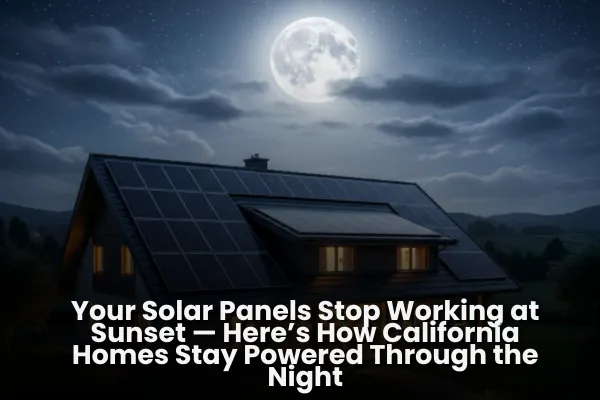
Your Solar Panels Stop Working at Sunset — Here’s How California Homes Stay Powered Through the Night
Your Solar Panels Stop Working at Sunset — Here's How California Homes Stay Powered Through the Night and Through Outages
Solar panels generate electricity when sunlight hits them. That part most people know. What fewer people fully reckon with — until they've had solar installed — is what happens at 6:30 PM when the sun drops below the horizon, the panels go dark, and the household enters its highest-consumption period of the day.
Dinner, Laundry, Television, Air conditioning running hard against residual afternoon heat. Kids on devices. Adults working late. For a typical California household, evening hours account for 40–60% of total daily electricity consumption — and none of it is covered by solar generation. Without a battery, that evening load comes entirely from the grid. Under SCE's time-of-use rates, that grid power is the most expensive power you'll buy all day.
With a battery, that evening load can come entirely from energy your panels generated for free during the afternoon. The difference shows up on your bill every month.
What Happens After Sunset Without a Battery?
A solar-only home — panels but no battery — is grid-dependent from the moment the sun goes down. The panels generate nothing. The inverter goes idle. Your home draws 100% of its evening power from SCE, PG&E, or SDG&E at whatever the current time-of-use rate happens to be.
Under SCE's TOU-D-PRIME rate, the peak window is 4 PM to 9 PM at rates commonly exceeding $0.50–0.65 per kWh. A home using 15 kWh of electricity during those five hours pays $7.50–9.75 for that single evening period. Over a month, that's $225–$292 in peak-hour charges alone.
Solar without storage does reduce your overall bill — it offsets daytime consumption when panels are generating. But it leaves the most expensive power window entirely untouched.
How a Battery Changes the Evening Equation?
A properly sized battery system stores surplus solar generation during the afternoon — typically between 10 AM and 3 PM when panels produce more than the home is consuming — and deploys that stored energy during the evening peak.
The result: your home runs on solar-generated energy long after the panels have stopped producing. Your 6 PM cooking, 7 PM laundry, and 9 PM air conditioning run are all powered by electricity your panels generated earlier in the day and stored for free.
You're not buying anything from SCE during peak hours. Your bill for that 4–9 PM window drops to near zero. A Tesla Powerwall 3 stores 13.5 kWh of usable energy. That's enough to cover most California households' peak-hour consumption. Homes with higher evening loads — large square footage, electric vehicles charging overnight, multiple occupants — may benefit from two batteries.
The NEM 3.0 Factor
Under California's current net billing rules (NEM 3.0), this dynamic is even more important than it was under the previous NEM 2.0 structure.
Under NEM 2.0, homeowners received generous credits for power exported to the grid during the day, which they used to offset evening grid purchases. That arbitrage worked reasonably well for solar-only systems.
Under NEM 3.0, daytime export credits are dramatically lower — roughly 75% less than under NEM 2.0 in many cases. Solar-only systems that rely on export credits to offset evening purchases are far less economically effective than they were before April 2023. Batteries solve this directly. Instead of exporting cheap surplus power to the grid and then buying expensive peak power back in the evening, a battery lets you keep that surplus on-site and use it when it's most valuable. You capture the full economic benefit of your solar generation rather than giving it to the utility at wholesale rates.
This is why solar-plus-battery under NEM 3.0 often produces better savings outcomes than solar-only did under NEM 2.0 for many Southern California homeowners.
Outage Protection: The Overnight Dimension
The sunset problem applies to outages too. If the grid goes down at 8 PM — during a heat wave or PSPS event — a solar-only home has no generation and no storage. The house goes dark.
A battery changes this entirely. At 8 PM, your Powerwall is fully charged from the day's solar generation. It powers your home through the night. The next morning, the panels come back online, recharge the battery, and the cycle continues — completely independent of whether the grid has restored power.
For California homeowners in PSPS-prone areas of Ventura County and surrounding communities, this overnight protection is not theoretical. It's the difference between a manageable inconvenience and a genuine hardship.
What Qualifying Homeowners Can Do?
My Home & Solar Solutions helps California homeowners access solar-plus-battery programs — including TPO options with no upfront equipment cost — that provide both the bill savings of evening battery dispatch and the resilience of overnight backup protection. We work with homes across Ventura County and the broader Southern California region, evaluating each home's usage profile, utility bill, and roof characteristics before recommending a system configuration.
The evening hours are when California's grid is most expensive and most strained. A battery gives you independence from both.
Visit https://myhomesolution.org/california_public_utility_commissions to find out if your home qualifies for a solar-plus-battery program that keeps you powered — day, night, and through whatever the grid throws at you.

MEET THE Team
My Home & Solar Solution is a virtual home‑energy brokerage committed to serving homeowners at the highest level as they navigate every stage of homeownership. Our mission is to build true financial literacy around the home—helping families understand their utility bills, evaluate financing options, and make smart long‑term decisions about their property. We design and broker rooftop solar, battery storage, roofing, and other energy‑efficient upgrades so homes become more resilient, more modern, and less expensive to operate. At the same time, we translate complex climate policy and utility politics into clear, practical insights, so homeowners can see how decisions made in Washington, Sacramento, and their local utility boardroom actually affect life—and costs—at home.
What We Cover...

Technological Innovations
Solar technology is advancing at an unprecedented pace. Our news page features updates on groundbreaking developments, including:
High-efficiency panels: Learn about the latest solar panels, including advancements in materials like perovskite and bifacial designs.
Energy storage: Discover innovations in battery technologies that enhance the reliability and scalability of solar systems.
Smart grids: Stay informed about how solar integrates with smart grid systems to optimize energy distribution.

Market Trends and Analysis
Understanding market dynamics is crucial for anyone involved in solar energy. Our articles delve into:
Solar adoption rates: Explore data on how solar installations are growing across residential, commercial, and industrial sectors.
Pricing trends: Get insights into the costs of solar panels, inverters, batteries, and installation services.
Investment opportunities: Stay ahead with information about renewable energy stocks, tax credits, and financial incentives.

Policy and Legislation
Solar energy thrives on supportive policies. Our coverage includes:
Federal and state incentives: Learn about tax credits, rebates, and grants available to solar adopters.
Regulations: Understand net metering policies, permitting processes, and compliance requirements.
Global policies: Discover how international agreements and policies impact the U.S. solar industry.

Environmental Impact
Renewable energy and smart home upgrades are essential in reducing carbon footprints and promoting sustainability. Our content highlights:
Carbon savings: Understand the environmental benefits of switching to renewable energy and energy-efficient technologies.
Sustainability practices: Explore how smart homes, energy storage, and eco-friendly upgrades contribute to broader sustainability goals.
Real World Impact: Discover case studies of successful projects that showcase how renewable energy and smart innovations benefit communities and ecosystems..

Solar Success Stories
Real-world applications of solar energy inspire and inform. We feature:
Residential installations: See how homeowners are transforming their energy usage with solar panels.
Business case studies: Learn about companies leading the charge in renewable energy adoption.
Community projects: Discover how solar energy is empowering underserved regions and creating jobs.

Challenges and Solutions
While solar energy offers numerous benefits, challenges remain. We address issues like:
Grid reliability: Explore how solar interacts with aging grid infrastructure.
Material sourcing: Understand the sustainability concerns related to raw materials for solar panels and batteries.
End-of-life management: Learn about recycling and disposal solutions for solar equipment.
Our Vision For The Future
At My Home & Solar Solutions, our vision extends beyond providing news.
We aim to:
Advocate for policy changes: Support initiatives that make renewable energy and home improvement upgrades more accessible and affordable.
Drive innovation: Partner with industry leaders to bring the latest technologies to market.
Promote sustainability: Champion practices that prioritize environmental health and resource conservation.
By aligning with these goals, we strive to create a platform that not only informs but also inspires action.
Why Choose My Home & Solar Solution for Your Home Improvement News?
We take pride in delivering:
Expertise: With over a decade of experience in the solar industry, we bring unparalleled knowledge to our reporting.
Accuracy: Our content is meticulously researched and verified to ensure reliability.
Relevance: We focus on topics that matter most to our audience, from homeowners to industry professionals.
Our commitment to quality has earned us a reputation as the authoritative source for solar news in the U.S. By choosing My Home & Solar Solution, you are choosing a partner dedicated to your energy independence and environmental stewardship
Facebook
Instagram
Youtube