
My Home & Solar Solutions Clean Energy Report
Clean Energy News
Transparent Reporting for a Sustainable Future
Latest News
AI Data Centers Are Raising Temperatures in Nearby Neighborhoods — and Your Cooling Bill Is Paying for It
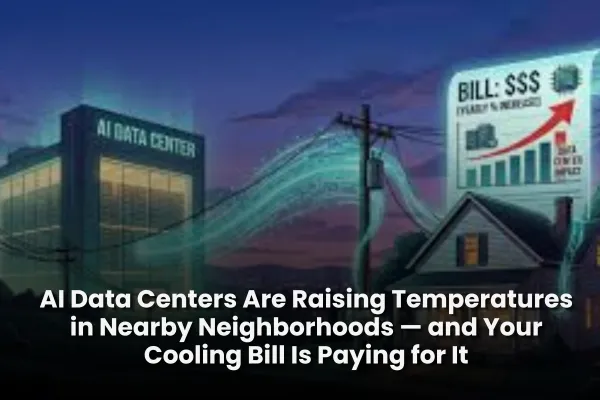
AI Data Centers Are Raising Temperatures in Nearby Neighborhoods — and Your Cooling Bill Is Paying for It
The conversation about AI's environmental footprint has largely focused on carbon emissions and energy consumption. Those concerns are valid and well-documented. But there's a more localized — and less-discussed — consequence of the data center boom that California homeowners in affected neighborhoods are beginning to notice: rising ambient temperatures and those rising temperatures are showing up on electric bills.
How Data Centers Generate Heat
A data center is, at its core, an enormous concentration of computing hardware running continuously at full load. Servers generate heat. That heat must be removed — continuously, efficiently, at scale — or the hardware fails.
Data centers use several cooling strategies, all of which transfer heat somewhere:
Air Cooling: Traditional data centers draw in ambient air, cool it, pass it over hot hardware, and exhaust the heated air outside. In a sufficiently large facility, the exhaust heat plumes can measurably warm the local air environment, particularly in areas with limited wind circulation.
Evaporative Cooling: Newer hyperscale facilities often use evaporative cooling towers, which transfer heat to water vapor released into the atmosphere. While this approach is more energy-efficient than pure air cooling, it contributes to local atmospheric moisture and heat load.
Liquid Cooling and Heat Rejection: Direct liquid cooling — where chilled water runs directly over hardware — is gaining adoption for the highest-density AI compute. The rejected heat must still be transferred somewhere, typically to cooling towers that release it into the surrounding air. The aggregate effect: a large data center campus — running 24 hours a day, 365 days a year — is a continuous heat source in its local environment. In a neighborhood already subject to the urban heat island effect, an adjacent data center can meaningfully elevate local temperatures, particularly during summer months.
The Research on Data Center Heat Islands
Research on data center heat island effects is emerging, though it remains limited compared to the broader literature on urban heat islands. What's been documented: Studies in data center-dense areas of the Netherlands, the United Kingdom, and Northern Virginia have found measurable temperature differentials near large data center facilities compared to surrounding areas without such concentrations. In some cases, researchers have documented temperature increases of 1–3°C (approximately 2–5°F) in immediate proximity to large hyperscale campuses during peak summer conditions. As AI-optimized data centers operate at higher power densities than traditional facilities, their per-square-foot heat rejection increases accordingly. A facility running GPU clusters for AI training generates significantly more heat per rack than a conventional web hosting data center. In California, where summer temperatures in inland areas can already exceed 110°F, even a modest localized temperature increase has consequences: more cooling load for nearby homes, more pressure on the grid during peak demand, and higher air conditioning bills for residents who had no say in where the data center was sited.
The Cooling Bill Connection
The relationship between ambient temperature and residential cooling costs is straightforward: higher temperatures mean more air conditioning. More air conditioning means more electricity consumption. More electricity consumption, under California's time-of-use rate structures, means higher bills — particularly during peak hours when rates are most expensive.
For a homeowner in a neighborhood adjacent to a data center campus, this can translate to meaningfully higher summer cooling bills — not because of anything they did, but because of the industrial heat load in their vicinity.
The effect is compounded by California's rate structure. SCE's TOU-D-PRIME rates charge the most for electricity used between 4 PM and 9 PM — exactly the hours when afternoon heat peaks and air conditioning demand is highest. A home that needed to run its air conditioner for four hours in the evening a decade ago may now need to run it for six hours, thanks to rising baseline temperatures from urban heat islands, climate change, and localized industrial heat sources.
That two-hour difference, at peak rates of $0.55–0.65/kWh, and with a 3-ton AC unit drawing 3.5 kW, costs an additional $3.85–4.55 per evening, or roughly $115–135 per month during peak cooling season.
The Regulatory Gap
California has regulations governing many aspects of large industrial facility development — environmental impact assessments, air quality permits, stormwater management. But the specific thermal impacts of data centers on adjacent residential neighborhoods are not a standard component of the regulatory review process. This means that when a data center company selects a site in or near a residential area, the heat rejection impact on neighbors is not typically required to be modeled, disclosed, or mitigated. Homeowners may not know a large data center is coming to their neighborhood until construction begins — and by then, the permitting is complete.
Some California legislators have begun exploring whether data center thermal impact disclosures should be required as part of environmental review. Industry groups have pushed back, arguing that existing regulations are sufficient and that data centers provide economic benefits that outweigh localized environmental effects. The debate will continue. In the meantime, the heat — and the cooling bills — are real.
What California Homeowners Can Do
You cannot relocate a data center. But you can reduce how much you're paying to cool your home because of the heat it generates. A solar-and-battery system addresses the data center cooling bill problem from two directions:
First, solar panels on your roof actively reduce your home's heat gain. Studies have consistently shown that homes with solar panels installed are cooler in summer than equivalent homes without panels — because the panels absorb solar radiation that would otherwise heat the roof, and that reduction in heat gain reduces cooling loads.
Second, a battery system allows you to store solar power during the day and use it to run your air conditioner during the evening peak hours — avoiding the expensive TOU rates that make summer cooling bills so painful. For homeowners in areas experiencing data center-driven temperature increases, solar-plus-battery storage is a direct response to a direct problem.
My Home & Solar Solutions works with qualifying California homeowners across Ventura County and the broader Southern California region to access solar and battery programs that require no upfront equipment purchase. If your electric bill is over $150/month — and rising every summer — it's worth finding out whether you qualify.
Visit www.myhomesolution.org to schedule a free consultation and find out what programs are available in your area.
AI is running hot. Your home doesn't have to.

MEET THE Team
My Home & Solar Solution is a virtual home‑energy brokerage committed to serving homeowners at the highest level as they navigate every stage of homeownership. Our mission is to build true financial literacy around the home—helping families understand their utility bills, evaluate financing options, and make smart long‑term decisions about their property. We design and broker rooftop solar, battery storage, roofing, and other energy‑efficient upgrades so homes become more resilient, more modern, and less expensive to operate. At the same time, we translate complex climate policy and utility politics into clear, practical insights, so homeowners can see how decisions made in Washington, Sacramento, and their local utility boardroom actually affect life—and costs—at home.
What We Cover...

Technological Innovations
Solar technology is advancing at an unprecedented pace. Our news page features updates on groundbreaking developments, including:
High-efficiency panels: Learn about the latest solar panels, including advancements in materials like perovskite and bifacial designs.
Energy storage: Discover innovations in battery technologies that enhance the reliability and scalability of solar systems.
Smart grids: Stay informed about how solar integrates with smart grid systems to optimize energy distribution.

Market Trends and Analysis
Understanding market dynamics is crucial for anyone involved in solar energy. Our articles delve into:
Solar adoption rates: Explore data on how solar installations are growing across residential, commercial, and industrial sectors.
Pricing trends: Get insights into the costs of solar panels, inverters, batteries, and installation services.
Investment opportunities: Stay ahead with information about renewable energy stocks, tax credits, and financial incentives.

Policy and Legislation
Solar energy thrives on supportive policies. Our coverage includes:
Federal and state incentives: Learn about tax credits, rebates, and grants available to solar adopters.
Regulations: Understand net metering policies, permitting processes, and compliance requirements.
Global policies: Discover how international agreements and policies impact the U.S. solar industry.

Environmental Impact
Renewable energy and smart home upgrades are essential in reducing carbon footprints and promoting sustainability. Our content highlights:
Carbon savings: Understand the environmental benefits of switching to renewable energy and energy-efficient technologies.
Sustainability practices: Explore how smart homes, energy storage, and eco-friendly upgrades contribute to broader sustainability goals.
Real World Impact: Discover case studies of successful projects that showcase how renewable energy and smart innovations benefit communities and ecosystems..

Solar Success Stories
Real-world applications of solar energy inspire and inform. We feature:
Residential installations: See how homeowners are transforming their energy usage with solar panels.
Business case studies: Learn about companies leading the charge in renewable energy adoption.
Community projects: Discover how solar energy is empowering underserved regions and creating jobs.

Challenges and Solutions
While solar energy offers numerous benefits, challenges remain. We address issues like:
Grid reliability: Explore how solar interacts with aging grid infrastructure.
Material sourcing: Understand the sustainability concerns related to raw materials for solar panels and batteries.
End-of-life management: Learn about recycling and disposal solutions for solar equipment.
Our Vision For The Future
At My Home & Solar Solutions, our vision extends beyond providing news.
We aim to:
Advocate for policy changes: Support initiatives that make renewable energy and home improvement upgrades more accessible and affordable.
Drive innovation: Partner with industry leaders to bring the latest technologies to market.
Promote sustainability: Champion practices that prioritize environmental health and resource conservation.
By aligning with these goals, we strive to create a platform that not only informs but also inspires action.
Why Choose My Home & Solar Solution for Your Home Improvement News?
We take pride in delivering:
Expertise: With over a decade of experience in the solar industry, we bring unparalleled knowledge to our reporting.
Accuracy: Our content is meticulously researched and verified to ensure reliability.
Relevance: We focus on topics that matter most to our audience, from homeowners to industry professionals.
Our commitment to quality has earned us a reputation as the authoritative source for solar news in the U.S. By choosing My Home & Solar Solution, you are choosing a partner dedicated to your energy independence and environmental stewardship
Facebook
Instagram
Youtube