My Home & Solar Solutions Clean Energy Report
Clean Energy News
Transparent Reporting for a Sustainable Future
Latest News
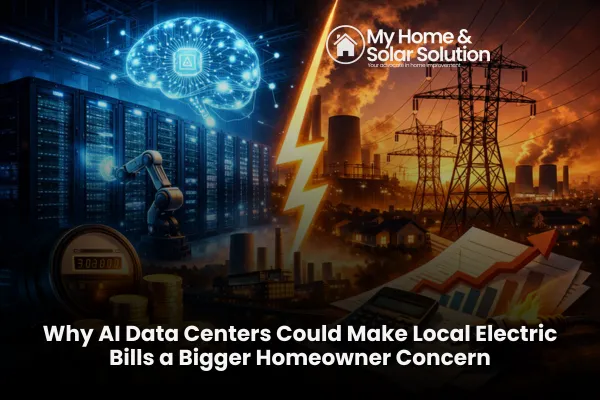
Why AI Data Centers Could Make Local Electric Bills a Bigger Homeowner Concern
Why AI Data Centers Could Make Local Electric Bills a Bigger Homeowner Concern
For most of the past decade, the drivers of California's rising electricity bills were well-understood if not well-liked: wildfire mitigation, aging infrastructure, renewable energy mandates. These were systemic challenges — statewide in scope, distributed in impact, and tied to forces that were clearly part of the California energy story. AI data centers are adding a new category of cost driver that has a different character: concentrated in specific communities, arriving faster than regulatory frameworks can adapt, and tied to an industry whose economic gains flow largely to shareholders and customers rather than to the communities bearing the infrastructure cost. This distinction matters for how California homeowners think about their electric bills — and it's emerging as a more significant concern than most homeowners currently realize.
The Community-Specific Impact
Unlike wildfire mitigation costs, which are distributed across all ratepayers in a utility's service territory because wildfire risk is broadly distributed, the infrastructure costs of large AI data centers are more concentrated. The substation built to serve a specific data center, the distribution line extended to reach a specific facility's location, the transmission upgrade triggered by a cluster of data centers in a specific region — these costs arise from specific locations and specific facilities. Yet under California's current regulatory framework, those costs are largely socialized across the rate base — shared among all residential customers in the utility's service territory, not just those in the communities adjacent to the data centers. The practical result: homeowners in communities that host or neighbor large AI data centers may face utility rate impacts from infrastructure investment that serves facilities they don't use, don't benefit from, and often didn't want in their community. This isn't purely theoretical. Energy economists studying utility rate cases in data center-heavy markets — Northern Virginia, parts of Texas, and increasingly California — have documented residential rate impacts that are statistically associated with data center infrastructure investment. The magnitudes are difficult to isolate precisely because regulatory accounting doesn't create the kind of cost attribution that would make clean analysis possible, but the directional relationship is consistent with the theory.
The Velocity Problem
What distinguishes AI data center load growth from previous periods of industrial load expansion is velocity — the speed at which large new loads are connecting to the grid.
Traditional industrial load growth in California — manufacturing facilities, distribution centers, large commercial buildings — happened incrementally, over years and decades, allowing utilities to incorporate new load into planning cycles and rate case filings in an orderly way. AI data centers are appearing in California at a pace that compresses years of planning into months. A hyperscale facility that might historically have taken 5–7 years from site selection to full operation is now being deployed in 18–24 months. The grid infrastructure required to serve that facility must be built on the same compressed timeline — often faster than the normal permitting, engineering, and construction cycles support. This velocity forces utilities into reactive infrastructure investment — spending capital in compressed timeframes with less cost scrutiny and competitive bidding than normal planning cycles allow. Emergency infrastructure procurement is typically more expensive than planned infrastructure. Those costs flow into rates.
Why Local Bills Could Become a Bigger Concern Over Time
Several factors suggest that the data center impact on local electricity bills will become more rather than less significant over the next several years:
Continued data center expansion: The AI investment cycle shows no signs of slowing, and California remains an attractive data center market despite high costs. More facilities means more infrastructure, more rate pressure. Infrastructure backlog: Grid infrastructure needed to serve existing data center demand hasn't fully caught up with actual connections. The rate impacts of infrastructure currently under construction will appear in rate cases over the next several years.
-Rate case timing: SCE's next major rate case filings will reflect capital spending from 2023–2025 — the period of most intense data center growth and infrastructure response. The rate impacts of that spending will be felt by residential customers beginning in 2026–2028.
Regulatory catch-up: As the CPUC develops better tools for tracking and attributing large load infrastructure costs, the picture of data center rate impacts on residential customers will become clearer — and potentially more alarming than the current incomplete accounting suggests.
What Homeowners in Data Center Communities Should Do
For homeowners in communities with existing or planned data center development — particularly in Ventura County's neighboring Inland Empire, Los Angeles County, and other SCE service territory communities — the data center rate concern is a concrete, not hypothetical, financial risk.
The near-term actions available to homeowners are:
Civic engagement: Participate in local planning processes where data center permits are discussed. Request water and electricity impact assessments as permit conditions. Support candidates and ballot measures that favor transparency in data center permitting.
Regulatory participation: Submit public comments to CPUC proceedings on large load cost allocation. Support ratepayer advocate organizations that represent residential customers in utility rate cases.
Energy independence: Reduce your household's dependence on utility rates shaped by industrial demands you can't control. A solar-plus-battery system reduces your grid consumption and your exposure to rate increases from whatever source.
My Home & Solar Solutions helps qualifying California homeowners take the energy independence step — immediately, with no upfront equipment cost for qualifying households.
Visit https://myhomesolution.org/2026-california-utility-bill-changes to learn more. AI data centers may be making your local electric bill a bigger concern. A solar-plus-battery home is one of the most direct and effective ways to respond.

MEET THE Team
My Home & Solar Solution is a virtual home‑energy brokerage committed to serving homeowners at the highest level as they navigate every stage of homeownership. Our mission is to build true financial literacy around the home—helping families understand their utility bills, evaluate financing options, and make smart long‑term decisions about their property. We design and broker rooftop solar, battery storage, roofing, and other energy‑efficient upgrades so homes become more resilient, more modern, and less expensive to operate. At the same time, we translate complex climate policy and utility politics into clear, practical insights, so homeowners can see how decisions made in Washington, Sacramento, and their local utility boardroom actually affect life—and costs—at home.
What We Cover...

Technological Innovations
Solar technology is advancing at an unprecedented pace. Our news page features updates on groundbreaking developments, including:
High-efficiency panels: Learn about the latest solar panels, including advancements in materials like perovskite and bifacial designs.
Energy storage: Discover innovations in battery technologies that enhance the reliability and scalability of solar systems.
Smart grids: Stay informed about how solar integrates with smart grid systems to optimize energy distribution.

Market Trends and Analysis
Understanding market dynamics is crucial for anyone involved in solar energy. Our articles delve into:
Solar adoption rates: Explore data on how solar installations are growing across residential, commercial, and industrial sectors.
Pricing trends: Get insights into the costs of solar panels, inverters, batteries, and installation services.
Investment opportunities: Stay ahead with information about renewable energy stocks, tax credits, and financial incentives.

Policy and Legislation
Solar energy thrives on supportive policies. Our coverage includes:
Federal and state incentives: Learn about tax credits, rebates, and grants available to solar adopters.
Regulations: Understand net metering policies, permitting processes, and compliance requirements.
Global policies: Discover how international agreements and policies impact the U.S. solar industry.

Environmental Impact
Renewable energy and smart home upgrades are essential in reducing carbon footprints and promoting sustainability. Our content highlights:
Carbon savings: Understand the environmental benefits of switching to renewable energy and energy-efficient technologies.
Sustainability practices: Explore how smart homes, energy storage, and eco-friendly upgrades contribute to broader sustainability goals.
Real World Impact: Discover case studies of successful projects that showcase how renewable energy and smart innovations benefit communities and ecosystems..

Solar Success Stories
Real-world applications of solar energy inspire and inform. We feature:
Residential installations: See how homeowners are transforming their energy usage with solar panels.
Business case studies: Learn about companies leading the charge in renewable energy adoption.
Community projects: Discover how solar energy is empowering underserved regions and creating jobs.

Challenges and Solutions
While solar energy offers numerous benefits, challenges remain. We address issues like:
Grid reliability: Explore how solar interacts with aging grid infrastructure.
Material sourcing: Understand the sustainability concerns related to raw materials for solar panels and batteries.
End-of-life management: Learn about recycling and disposal solutions for solar equipment.
Our Vision For The Future
At My Home & Solar Solutions, our vision extends beyond providing news.
We aim to:
Advocate for policy changes: Support initiatives that make renewable energy and home improvement upgrades more accessible and affordable.
Drive innovation: Partner with industry leaders to bring the latest technologies to market.
Promote sustainability: Champion practices that prioritize environmental health and resource conservation.
By aligning with these goals, we strive to create a platform that not only informs but also inspires action.
Why Choose My Home & Solar Solution for Your Home Improvement News?
We take pride in delivering:
Expertise: With over a decade of experience in the solar industry, we bring unparalleled knowledge to our reporting.
Accuracy: Our content is meticulously researched and verified to ensure reliability.
Relevance: We focus on topics that matter most to our audience, from homeowners to industry professionals.
Our commitment to quality has earned us a reputation as the authoritative source for solar news in the U.S. By choosing My Home & Solar Solution, you are choosing a partner dedicated to your energy independence and environmental stewardship
Facebook
Instagram
Youtube