My Home & Solar Solutions Clean Energy Report
Clean Energy News
Transparent Reporting for a Sustainable Future
Latest News
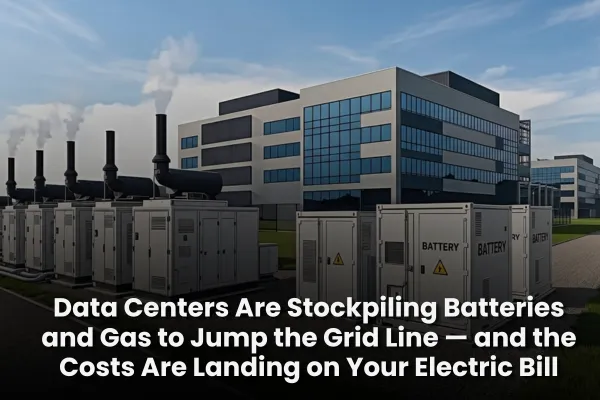
Data Centers Are Stockpiling Batteries and Gas to Jump the Grid Line — and the Costs Are Landing on Your Electric Bill
Data Centers Are Stockpiling Batteries and Gas to Jump the Grid Line — and the Costs Are Landing on Your Electric Bill
Something is happening in the American energy market that most residential utility customers don't know about — and the costs are quietly showing up on every California electric bill. Across the country, tech companies building AI data centers are running into a problem: the grid can't connect them fast enough. Utility interconnection queues — the formal process by which a new large electricity customer gets connected to the grid — can take three to seven years to complete. For a tech company trying to deploy AI infrastructure at speed, that wait is unacceptable. So they're finding workarounds. And those workarounds are reshaping the economics of the California grid in ways that every homeowner with an SCE, PG&E, or SDG&E account should understand.
The Grid Queue Problem
To understand why data centers are stockpiling their own energy resources, you need to understand how grid interconnection works.
When a new large electricity consumer — or generator — wants to connect to the transmission grid, they submit an interconnection request to the relevant utility or grid operator. That request triggers a study process to assess what infrastructure upgrades are needed to support the new load or generation. Other applicants who submitted requests earlier have priority. The queue can stretch for years.
As of 2025, CAISO — California's grid operator — had one of the most backlogged interconnection queues in the country. Thousands of projects, representing hundreds of gigawatts of potential capacity, were waiting to connect. New AI data center projects seeking grid power were facing the same bottleneck.
The Workarounds: Batteries, Gas, and On-Site Generation
Facing years-long waits for grid interconnection, tech companies have adopted several strategies to get their data centers powered faster:
On-Site Battery Storage: Some operators are installing large-scale battery systems at their data center facilities — not primarily to reduce costs, but to bridge the gap between when they start operating and when full grid interconnection is achieved. These batteries can be charged from whatever limited grid access is available, then discharged to cover load when demand exceeds supply.
Emergency and Standby Gas Generators: Data centers have long maintained diesel and natural gas backup generators for emergency use. In the current environment, some facilities are expanding their generator capacity and permitting it for more regular use — essentially running on fossil fuels while waiting for the grid to catch up.
Power Purchase Agreements That Prioritize Data Center Load: Tech companies are signing long-term PPAs that effectively reserve generation capacity ahead of other grid users. These agreements can drive up procurement costs for utilities, which are passed through to residential rates.
Private Microgrids and Direct Interconnection: Some hyperscale operators are pursuing direct interconnection to transmission lines, bypassing local distribution infrastructure. This can require significant utility cooperation — and often involves cost-sharing agreements that socialize some of the infrastructure upgrade costs across the broader ratepayer base.
How This Lands on Your Bill
The connection between data center load growth and residential utility rates is direct, even if it's not visible on your bill as a line item.
More load on the grid — particularly large, concentrated, high-demand loads like AI data centers — requires more infrastructure investment by utilities. Transmission upgrades, new substations, distribution reinforcements: all of these are capital expenditures that flow through CPUC-approved rate cases into residential customer bills.
When a tech company negotiates a direct interconnection that requires a new substation, and that substation cost is partially socialized across the rate base, every residential customer in that utility's service territory is effectively subsidizing the data center's infrastructure.
The scale of this effect is hard to quantify precisely — utilities don't break out rate impacts by cause in a way that makes data center contributions transparent. But energy economists and utility regulators have been increasingly vocal about the need for large industrial loads to bear their fair share of infrastructure costs, rather than externalizing them onto residential ratepayers.
The Irony of Battery Stockpiling
Here's the irony that California homeowners are in a unique position to appreciate: the same battery technology that data centers are stockpiling to ensure their power supply is available — right now — to California homeowners through solar-plus-storage programs.
A Tesla Powerwall installed at your home does for you what a large-scale battery system does for a data center: it provides reliable power when grid supply is uncertain or expensive, and it reduces dependence on a grid that is increasingly strained by industrial demand.
The difference is that data centers are using batteries to keep their operations running at any cost. Homeowners who install battery storage are using them to cut costs — typically saving $1,500 to $3,000 per year on their electric bills while gaining the same kind of resilience and unlike a data center, a home battery paired with solar generates its own clean power to charge itself — creating a genuine energy independence loop that a diesel generator or grid-charged battery can't match.
What This Means for Grid Reliability
California's grid operator, CAISO, has been clear: demand from AI and data center growth is one of the biggest threats to near-term grid reliability. The grid was not designed to absorb this level of large industrial load growth in such a compressed timeframe.
The risk for residential customers: more frequent grid stress events, more Public Safety Power Shutoffs (PSPS) during high-demand periods, and higher costs for procuring the peaking power needed to serve concentrated industrial load.
Distributed solar and battery storage — installed across hundreds of thousands of homes — is one of the most effective tools available to reduce grid stress. Homes with batteries can absorb their own load during peak periods rather than drawing from the grid, effectively acting as a distributed buffer against industrial demand spikes. This is not just good for individual homeowners. It's good for everyone on the grid.
Taking Control
You cannot control how fast AI companies build data centers or how the CPUC allocates infrastructure costs. But you can control how much of your household electricity comes from a strained, expensive grid — and how much comes from solar panels on your own roof, stored in your own battery.
My Home & Solar Solutions helps qualifying California homeowners make the transition to solar and battery backup through programs that require no upfront equipment purchase. For homeowners paying over $150/month to SCE, PG&E, or SDG&E, there's a real financial case for acting now — before the next rate increase and before program terms change.
Visit https://myhomesolution.org/california_public_utility_commissions to find out what programs are available in your area and whether your home qualifies.
The data centers are stockpiling energy resources. So can you. The difference is, yours will actually lower your bill.

MEET THE Team
My Home & Solar Solution is a virtual home‑energy brokerage committed to serving homeowners at the highest level as they navigate every stage of homeownership. Our mission is to build true financial literacy around the home—helping families understand their utility bills, evaluate financing options, and make smart long‑term decisions about their property. We design and broker rooftop solar, battery storage, roofing, and other energy‑efficient upgrades so homes become more resilient, more modern, and less expensive to operate. At the same time, we translate complex climate policy and utility politics into clear, practical insights, so homeowners can see how decisions made in Washington, Sacramento, and their local utility boardroom actually affect life—and costs—at home.
What We Cover...

Technological Innovations
Solar technology is advancing at an unprecedented pace. Our news page features updates on groundbreaking developments, including:
High-efficiency panels: Learn about the latest solar panels, including advancements in materials like perovskite and bifacial designs.
Energy storage: Discover innovations in battery technologies that enhance the reliability and scalability of solar systems.
Smart grids: Stay informed about how solar integrates with smart grid systems to optimize energy distribution.

Market Trends and Analysis
Understanding market dynamics is crucial for anyone involved in solar energy. Our articles delve into:
Solar adoption rates: Explore data on how solar installations are growing across residential, commercial, and industrial sectors.
Pricing trends: Get insights into the costs of solar panels, inverters, batteries, and installation services.
Investment opportunities: Stay ahead with information about renewable energy stocks, tax credits, and financial incentives.

Policy and Legislation
Solar energy thrives on supportive policies. Our coverage includes:
Federal and state incentives: Learn about tax credits, rebates, and grants available to solar adopters.
Regulations: Understand net metering policies, permitting processes, and compliance requirements.
Global policies: Discover how international agreements and policies impact the U.S. solar industry.

Environmental Impact
Renewable energy and smart home upgrades are essential in reducing carbon footprints and promoting sustainability. Our content highlights:
Carbon savings: Understand the environmental benefits of switching to renewable energy and energy-efficient technologies.
Sustainability practices: Explore how smart homes, energy storage, and eco-friendly upgrades contribute to broader sustainability goals.
Real World Impact: Discover case studies of successful projects that showcase how renewable energy and smart innovations benefit communities and ecosystems..

Solar Success Stories
Real-world applications of solar energy inspire and inform. We feature:
Residential installations: See how homeowners are transforming their energy usage with solar panels.
Business case studies: Learn about companies leading the charge in renewable energy adoption.
Community projects: Discover how solar energy is empowering underserved regions and creating jobs.

Challenges and Solutions
While solar energy offers numerous benefits, challenges remain. We address issues like:
Grid reliability: Explore how solar interacts with aging grid infrastructure.
Material sourcing: Understand the sustainability concerns related to raw materials for solar panels and batteries.
End-of-life management: Learn about recycling and disposal solutions for solar equipment.
Our Vision For The Future
At My Home & Solar Solutions, our vision extends beyond providing news.
We aim to:
Advocate for policy changes: Support initiatives that make renewable energy and home improvement upgrades more accessible and affordable.
Drive innovation: Partner with industry leaders to bring the latest technologies to market.
Promote sustainability: Champion practices that prioritize environmental health and resource conservation.
By aligning with these goals, we strive to create a platform that not only informs but also inspires action.
Why Choose My Home & Solar Solution for Your Home Improvement News?
We take pride in delivering:
Expertise: With over a decade of experience in the solar industry, we bring unparalleled knowledge to our reporting.
Accuracy: Our content is meticulously researched and verified to ensure reliability.
Relevance: We focus on topics that matter most to our audience, from homeowners to industry professionals.
Our commitment to quality has earned us a reputation as the authoritative source for solar news in the U.S. By choosing My Home & Solar Solution, you are choosing a partner dedicated to your energy independence and environmental stewardship
Facebook
Instagram
Youtube