My Home & Solar Solutions Clean Energy Report
Clean Energy News
Transparent Reporting for a Sustainable Future
Latest News
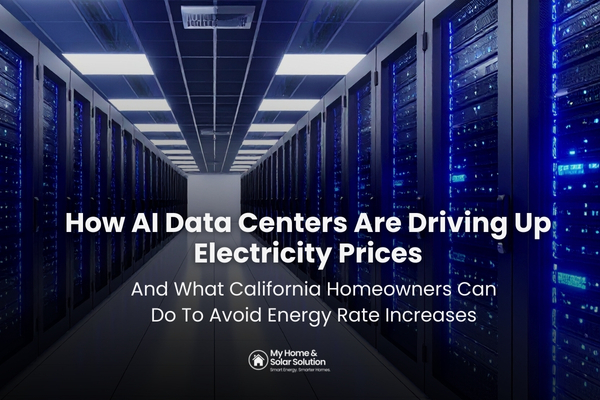
How AI Data Centers Are Driving Up Electricity Prices
How AI Data Centers Are Driving Up Electricity Prices And What SoCal Homeowners Can Do To Avoid Rate Increases
Over the last year, something unexpected has been happening behind the scenes of America’s power grid: AI data centers are expanding faster than utilities can keep up, and the ripple effects are landing directly on residential utility bills — including right here in Southern California.
While most people see AI as a software revolution, the truth is far more physical. These facilities consume enormous amounts of electricity, and utilities are scrambling to build the extra capacity needed to power them. The cost of those upgrades doesn’t stay with the tech companies — it’s getting passed down to everyday homeowners.
(Lawrence Berkeley National Laboratory; Reuters/NERC)
And that’s where the story becomes personal.
A Sudden Surge in Energy Demand
Across the U.S., electricity demand has jumped in ways utilities haven’t seen in decades. AI servers use far more energy than traditional data centers, and new facilities are being built at record speed.
Research from Lawrence Berkeley National Laboratory shows that data centers currently consume about 4.4% of America’s electricity, and could use 6.7% to 12% by 2028 — nearly triple today’s levels.[1] Some regions near major AI hubs have already seen residential electricity costs double compared to five years ago, driven largely by wholesale price spikes.^[2]
This isn’t a distant worry. It’s happening now.
How This Affects Southern California Homeowners
SoCal isn’t home to massive AI data campuses, but we share the same grid that powers them. The California Public Utility Commission (CPUC) regulates three of the largest investor owned utilities such as PG&E, SDG&E and SoCalEdison; hiking up rates year after year to offset lawsuits and increased energy demand. When major corporate users lock in enormous blocks of low-cost electricity, utilities often shift the remaining grid upgrade costs onto residential customers.(Pew Research Center)
That’s why homeowners across the California service area have seen:
Steady year-over-year rate increases
Higher delivery and transmission charges
More aggressive peak pricing
Larger seasonal swings
Extra pressure during wildfire and summer-demand seasons
The equation is simple: When the grid is strained, households feel it first.
Why Prices Are Rising Faster Now
Here’s what’s driving the price pressure:
AI data centers run around the clock and require huge, constant power
Utilities must rapidly build new power lines, substations, and transformers
These upgrades cost billions
Large corporations negotiate favorable long-term utility contracts
The remaining burden shifts to families and small businesses
Several states are already seeking rate hikes specifically tied to meeting new data center demands — including projected $16–$20 monthly increases in regions like Maryland and Ohio.^[3]
Policy is slow. Bills are not.
So What Can Homeowners Actually Do?
The clearest protection from rising grid prices is to produce your own power and reduce dependence on utility electricity during expensive hours.
For California residents, the best solutions are:
1. Solar
Solar allows homeowners to replace unpredictable grid pricing with a lower, more stable rate.
2. Battery Backup
Batteries provide protection during blackouts, wildfire shutoffs, and summer peaks — while helping avoid the highest-priced time-of-use periods. For many SCE, PG&E, and SDG&E homeowners, a battery does more than provide blackout protection — it can also become a small, steady source of value. When your home produces more solar energy than you need, your battery can export that excess power back to the grid during high-demand hours. Utilities offer credits for this exported energy, reducing your bill and helping stabilize the local grid when it’s under pressure. It’s a quiet, elegant form of energy sharing: your home contributes clean power when the community needs it most, and in return, you receive financial relief on your monthly statement. Over time, these credits can offset a meaningful portion of your electricity costs while turning your home into part of the solution.
3. $0-Down Power Purchase Programs (PPAs)
This is one of the simplest ways to access clean, reliable energy without leasing, financing or buying equipment.
A Power Purchase Program:
Requires $0 out-of-pocket for the equipment, installation, maintenance etc
This means the power program providers are covering installation, equipment, monitoring, and maintenance for 25 years.
The benefit for homeowners? The solar and battery storage becomes your new source of energy so that you do not have to rely on expensive grid power from the utility. Replaces your utility bill with a lower, predictable energy rate.
Shields you from future rate hikes
Gives you solar + battery power without being liable for battery replacement costs, maintenance, or repairs.
You don’t buy panels. You don’t buy batteries.
You simply purchase the power they generate — at a lower rate than the utility.
And this isn’t a new concept. It’s how the world’s biggest brands protect their energy budgets.
META, Google, Amazon, Apple — all rely on massive Power Purchase Agreements.
They lock in long-term clean energy at predictable pricing to defend themselves from the same volatility homeowners face — just on a far larger scale.
If Fortune 500 companies count on PPAs for stability, homeowners can too.
4. Long-Term Stability
Solar, storage, or a PPA allows families to step off the roller coaster of unpredictable grid pricing and into a future where monthly energy costs feel steady and secure.
A Local Example: Ventura County
A Ventura County homeowner recently switched to a solar + battery PPA after watching their SCE bill rise 38% over the past few seasons. They locked in a flat, predictable rate for energy, added blackout protection, and cut their summer bill nearly in half. They went from paying .40 cents a kwh to SCE with frequent blackouts to paying .20 cents a kWh. They get to use more energy, rely on their Tesla Powerwall 3's when the grid goes down and save money from day one sense they didn't have to take out a loan, lease, or pay cash for the system.
Stories like this are becoming common — because the pressure on the grid is becoming impossible to ignore.
Bottom Line
AI is reshaping almost every industry, but its energy appetite is reshaping America’s power grid even faster. That means higher bills, more volatility, and more strain on households unless families take steps to protect themselves.
California homeowners don’t have to wait for the next rate hike.
There’s a more stable, empowered way forward.
See what your home qualifies for: LEARN MORE
Sources
Lawrence Berkeley National Laboratory — U.S. Data Centers Expected to Consume 6.7%–12% of National Electricity by 2028
https://newscenter.lbl.gov/2025/01/15/berkeley-lab-report-evaluates-increase-in-electricity-demand-from-data-centers/Bloomberg — Electricity Costs Are Up to 267% Higher in Regions Near Data Centers
https://www.bloomberg.com/graphics/2025-ai-data-centers-electricity-prices/Pew Research Center — Residential Bills Expected to Rise $16–$20 in Several Regions Due to Data Center Demand
https://www.pewresearch.org/short-reads/2025/10/24/what-we-know-about-energy-use-at-us-data-centers-amid-the-ai-boom/Reuters — NERC Warns of Tightening Electricity Supplies Amid Data Center Growth
https://www.reuters.com/business/energy/us-data-center-demand-raising-power-risks-this-winter-regulator-says-2025-11-18/International Energy Agency (IEA) — AI and Data Centers Set to Drive Surging Electricity Demand
https://www.iea.org/news/ai-is-set-to-drive-surging-electricity-demand-from-data-centres

MEET THE Team
My Home & Solar Solution is a virtual home‑energy brokerage committed to serving homeowners at the highest level as they navigate every stage of homeownership. Our mission is to build true financial literacy around the home—helping families understand their utility bills, evaluate financing options, and make smart long‑term decisions about their property. We design and broker rooftop solar, battery storage, roofing, and other energy‑efficient upgrades so homes become more resilient, more modern, and less expensive to operate. At the same time, we translate complex climate policy and utility politics into clear, practical insights, so homeowners can see how decisions made in Washington, Sacramento, and their local utility boardroom actually affect life—and costs—at home.
What We Cover...

Technological Innovations
Solar technology is advancing at an unprecedented pace. Our news page features updates on groundbreaking developments, including:
High-efficiency panels: Learn about the latest solar panels, including advancements in materials like perovskite and bifacial designs.
Energy storage: Discover innovations in battery technologies that enhance the reliability and scalability of solar systems.
Smart grids: Stay informed about how solar integrates with smart grid systems to optimize energy distribution.

Market Trends and Analysis
Understanding market dynamics is crucial for anyone involved in solar energy. Our articles delve into:
Solar adoption rates: Explore data on how solar installations are growing across residential, commercial, and industrial sectors.
Pricing trends: Get insights into the costs of solar panels, inverters, batteries, and installation services.
Investment opportunities: Stay ahead with information about renewable energy stocks, tax credits, and financial incentives.

Policy and Legislation
Solar energy thrives on supportive policies. Our coverage includes:
Federal and state incentives: Learn about tax credits, rebates, and grants available to solar adopters.
Regulations: Understand net metering policies, permitting processes, and compliance requirements.
Global policies: Discover how international agreements and policies impact the U.S. solar industry.

Environmental Impact
Renewable energy and smart home upgrades are essential in reducing carbon footprints and promoting sustainability. Our content highlights:
Carbon savings: Understand the environmental benefits of switching to renewable energy and energy-efficient technologies.
Sustainability practices: Explore how smart homes, energy storage, and eco-friendly upgrades contribute to broader sustainability goals.
Real World Impact: Discover case studies of successful projects that showcase how renewable energy and smart innovations benefit communities and ecosystems..

Solar Success Stories
Real-world applications of solar energy inspire and inform. We feature:
Residential installations: See how homeowners are transforming their energy usage with solar panels.
Business case studies: Learn about companies leading the charge in renewable energy adoption.
Community projects: Discover how solar energy is empowering underserved regions and creating jobs.

Challenges and Solutions
While solar energy offers numerous benefits, challenges remain. We address issues like:
Grid reliability: Explore how solar interacts with aging grid infrastructure.
Material sourcing: Understand the sustainability concerns related to raw materials for solar panels and batteries.
End-of-life management: Learn about recycling and disposal solutions for solar equipment.
Our Vision For The Future
At My Home & Solar Solutions, our vision extends beyond providing news.
We aim to:
Advocate for policy changes: Support initiatives that make renewable energy and home improvement upgrades more accessible and affordable.
Drive innovation: Partner with industry leaders to bring the latest technologies to market.
Promote sustainability: Champion practices that prioritize environmental health and resource conservation.
By aligning with these goals, we strive to create a platform that not only informs but also inspires action.
Why Choose My Home & Solar Solution for Your Home Improvement News?
We take pride in delivering:
Expertise: With over a decade of experience in the solar industry, we bring unparalleled knowledge to our reporting.
Accuracy: Our content is meticulously researched and verified to ensure reliability.
Relevance: We focus on topics that matter most to our audience, from homeowners to industry professionals.
Our commitment to quality has earned us a reputation as the authoritative source for solar news in the U.S. By choosing My Home & Solar Solution, you are choosing a partner dedicated to your energy independence and environmental stewardship
Facebook
Instagram
Youtube