My Home & Solar Solutions Clean Energy Report
Clean Energy News
Transparent Reporting for a Sustainable Future
Latest News
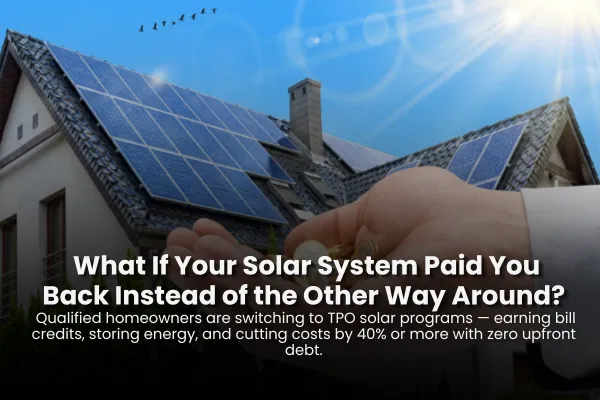
What If Your Solar System Paid You Back Instead of the Other Way Around? Qualified homeowners are switching to TPO solar programs — earning bill credits, storing energy, and cutting costs by 40% or more with zero upfront debt.
What If Your Solar System Paid You Back Instead of the Other Way Around?
Qualified Homeowners Are Switching to TPO Solar Programs — Earning Bill Credits, Storing Energy, and Cutting Costs by 40% or More With Zero Upfront Debt.
Most people think about going solar the way they think about buying a car: you pay a lot of money upfront (or take out a big loan), and you hope the long-term savings justify the initial expense. That model exists. It works for some homeowners. But it's not the only model — and for many California homeowners, it's not even the best one. There's a different structure that's been quietly gaining traction in California since the CPUC finalized NEM 3.0 rules: third-party ownership, or TPO. And for qualifying homeowners, it flips the financial equation entirely. Instead of paying for solar, your solar system starts paying you back — from month one.
What Is TPO Solar?
Third-party ownership (TPO) is a model in which a program partner — not you — owns the solar panels and battery storage installed on your home. The partner handles everything: equipment procurement, installation, permitting, monitoring, and maintenance. If something breaks, they fix it.
You, the homeowner, don't buy anything and don't take out a loan. Instead, you pay a fixed monthly program fee for the energy your system produces. That fee is typically set significantly below your current utility bill — in many cases 30–50% lower.
The program partner benefits from federal tax incentives (the Investment Tax Credit and accelerated depreciation), utility program incentives, and the long-term revenue stream from your monthly payments. You benefit from lower electricity costs, backup power during outages, and a fully maintained system on your roof with zero financial risk.
It's a structure that aligns everyone's interests: the partner needs the system to perform well to make money, so they're motivated to install high-quality equipment and keep it running. You need savings to justify participating, so you're motivated to pick a reputable partner.
How Bill Credits Work Under NEM 3.0
Under California's current Net Billing (NEM 3.0) structure, the economics of solar shifted significantly — but not in a way that eliminates savings. It just changed where the savings come from.
Under NEM 2.0, most solar savings came from exporting excess power to the grid during the day and receiving generous credits against your evening and nighttime usage. Under NEM 3.0, export credits are much lower, but the savings from self-consumption — using your own solar power instead of buying grid power — remain substantial.
A TPO system paired with battery storage maximizes self-consumption by:
Capturing solar power during peak generation hours (10 AM – 3 PM) in the battery rather than exporting it to the grid at low credit rates. Using that stored power during peak pricing hours (4 PM – 9 PM) when grid electricity from SCE or PG&E is most expensive. Exporting any remaining surplus during specific windows when NEM 3.0 export rates are higher — typically during morning ramp periods or grid stress events.
The net result: a well-configured TPO system with battery storage can reduce a Southern California homeowner's utility bill by 40–70% — sometimes more, depending on system size, usage profile, and utility rate structure. The 40% Figure: What It Actually Looks Like
Let's put real numbers on it.
Homeowner A is in Ventura County, on SCE service, and currently paying $280/month for electricity. Her bill peaks in summer when she runs air conditioning, and she's noticed her bill has gone up every year for the past four years. Under a TPO program, Homeowner A's roof is assessed. Her system — say, 10 kW of solar plus a Tesla Powerwall — is designed to cover roughly 85% of her consumption. Her monthly program fee is set at $160.
Her utility bill for the remaining grid power she draws: approximately $40–60/month during most months.
Total monthly energy cost: $200–220, down from $280. That's a savings of $60–80/month, or $720–960 per year — with no money down, no loan, and no maintenance responsibility and that's before accounting for the fact that SCE rates are likely to increase again in 2026 and 2027. Every rate increase makes her program fee — which is fixed — a better deal relative to what she'd be paying on the grid.
The Battery: Where the Real Magic Happens
In a TPO system, the battery is not optional — it's the difference between marginal savings and transformative savings.
Here's why:
without a battery, your solar panels generate power during the day while you're at work. That power either gets used (good) or exported to the grid at the low NEM 3.0 rate (not great). When you come home in the evening and start using electricity — cooking, laundry, TV, AC — you're buying it from SCE at peak rates.
With a battery, that daytime solar power is stored and deployed in the evening. You're not buying anything from SCE at peak rates because your battery is covering your evening load. The battery is the mechanism by which solar becomes a true bill-reduction tool under NEM 3.0 — not just a nice-to-have, but the core of the savings strategy.
Tesla Powerwall systems are among the most widely deployed home battery solutions in California, with a track record of reliability, a monitoring app that lets homeowners track savings in real time, and compatibility with the time-of-use optimization required for maximum benefit under NEM 3.0 rate structures.
Who Qualifies for TPO Programs?
TPO programs aren't available to every homeowner in every location. Qualifying criteria typically include:
- You own your home (renters generally don't qualify)
- Your monthly electricity bill is above a minimum threshold (commonly $150–200/month)
- Your roof is in adequate condition and suitable for solar (south or west-facing is ideal, but not required)
- Your home is in the service territory of a participating utility (PG&E, SCE, or SDG&E)
- Your credit profile meets program partner requirements (though many programs have flexible criteria)
Homes in areas with high wildfire risk, frequent PSPS events, or histories of long outages often have additional motivation to qualify — backup power becomes a safety and economic necessity, not just a convenience.
Why Now?
NEM 3.0 has been in effect since April 2023. The program partners who've built their systems around the new rate structure — designing for self-consumption and storage optimization rather than export — are the ones producing the best results for homeowners today.
But program terms change. CPUC decisions evolve. Utility incentive structures get modified. The homeowners who enroll now do so under current terms — terms that are favorable for well-designed solar-plus-battery systems.
Waiting means paying more to the utility in the meantime, and potentially enrolling later under terms that may be less advantageous.
Find Out If You Qualify
My Home & Solar Solutions helps qualifying California homeowners understand their options under the current net billing structure and identify TPO programs that fit their situation.
Visit https://myhomesolution.org/california_public_utility_commissions to learn more and schedule a free assessment. We'll review your utility bills, your roof, and your usage profile — and tell you honestly whether a TPO solar-plus-battery program makes sense for your home.
Your solar system should be paying you back. Let's find out if yours can.

MEET THE Team
My Home & Solar Solution is a virtual home‑energy brokerage committed to serving homeowners at the highest level as they navigate every stage of homeownership. Our mission is to build true financial literacy around the home—helping families understand their utility bills, evaluate financing options, and make smart long‑term decisions about their property. We design and broker rooftop solar, battery storage, roofing, and other energy‑efficient upgrades so homes become more resilient, more modern, and less expensive to operate. At the same time, we translate complex climate policy and utility politics into clear, practical insights, so homeowners can see how decisions made in Washington, Sacramento, and their local utility boardroom actually affect life—and costs—at home.
What We Cover...

Technological Innovations
Solar technology is advancing at an unprecedented pace. Our news page features updates on groundbreaking developments, including:
High-efficiency panels: Learn about the latest solar panels, including advancements in materials like perovskite and bifacial designs.
Energy storage: Discover innovations in battery technologies that enhance the reliability and scalability of solar systems.
Smart grids: Stay informed about how solar integrates with smart grid systems to optimize energy distribution.

Market Trends and Analysis
Understanding market dynamics is crucial for anyone involved in solar energy. Our articles delve into:
Solar adoption rates: Explore data on how solar installations are growing across residential, commercial, and industrial sectors.
Pricing trends: Get insights into the costs of solar panels, inverters, batteries, and installation services.
Investment opportunities: Stay ahead with information about renewable energy stocks, tax credits, and financial incentives.

Policy and Legislation
Solar energy thrives on supportive policies. Our coverage includes:
Federal and state incentives: Learn about tax credits, rebates, and grants available to solar adopters.
Regulations: Understand net metering policies, permitting processes, and compliance requirements.
Global policies: Discover how international agreements and policies impact the U.S. solar industry.

Environmental Impact
Renewable energy and smart home upgrades are essential in reducing carbon footprints and promoting sustainability. Our content highlights:
Carbon savings: Understand the environmental benefits of switching to renewable energy and energy-efficient technologies.
Sustainability practices: Explore how smart homes, energy storage, and eco-friendly upgrades contribute to broader sustainability goals.
Real World Impact: Discover case studies of successful projects that showcase how renewable energy and smart innovations benefit communities and ecosystems..

Solar Success Stories
Real-world applications of solar energy inspire and inform. We feature:
Residential installations: See how homeowners are transforming their energy usage with solar panels.
Business case studies: Learn about companies leading the charge in renewable energy adoption.
Community projects: Discover how solar energy is empowering underserved regions and creating jobs.

Challenges and Solutions
While solar energy offers numerous benefits, challenges remain. We address issues like:
Grid reliability: Explore how solar interacts with aging grid infrastructure.
Material sourcing: Understand the sustainability concerns related to raw materials for solar panels and batteries.
End-of-life management: Learn about recycling and disposal solutions for solar equipment.
Our Vision For The Future
At My Home & Solar Solutions, our vision extends beyond providing news.
We aim to:
Advocate for policy changes: Support initiatives that make renewable energy and home improvement upgrades more accessible and affordable.
Drive innovation: Partner with industry leaders to bring the latest technologies to market.
Promote sustainability: Champion practices that prioritize environmental health and resource conservation.
By aligning with these goals, we strive to create a platform that not only informs but also inspires action.
Why Choose My Home & Solar Solution for Your Home Improvement News?
We take pride in delivering:
Expertise: With over a decade of experience in the solar industry, we bring unparalleled knowledge to our reporting.
Accuracy: Our content is meticulously researched and verified to ensure reliability.
Relevance: We focus on topics that matter most to our audience, from homeowners to industry professionals.
Our commitment to quality has earned us a reputation as the authoritative source for solar news in the U.S. By choosing My Home & Solar Solution, you are choosing a partner dedicated to your energy independence and environmental stewardship
Facebook
Instagram
Youtube