
My Home & Solar Solutions Clean Energy Report
Clean Energy News
Transparent Reporting for a Sustainable Future
Latest News
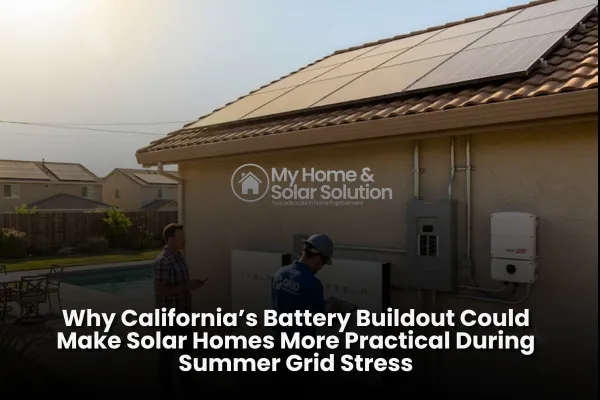
Why California’s Battery Buildout Could Make Solar Homes More Practical During Summer Grid Stress
Why California's Battery Buildout Could Make Solar Homes More Practical During Summer Grid Stress
California's grid is in the middle of an extraordinary storage transformation. From essentially zero grid-scale battery capacity a decade ago, California has deployed over 17,000 megawatts of battery storage — a buildout that is reshaping how the grid operates during the periods of highest stress. This transformation has important implications for California homeowners with solar panels and home batteries. As grid-scale storage makes the broader grid more stable, the interaction between home solar, home batteries, and the larger storage infrastructure creates new opportunities — particularly during summer, when grid stress is highest and the economic stakes of smart energy management are greatest. Understanding how California's battery buildout affects home solar and battery economics is increasingly relevant for homeowners making energy decisions.
What California's Grid Storage Buildup Has Already Done
The most visible impact of California's grid-scale battery deployment is on the infamous "duck curve" — the pattern of CAISO net load that dips deeply in the afternoon (when solar is generating abundantly) and spikes steeply in the evening (when solar drops and demand peaks).
Before significant grid-scale storage, this evening ramp required expensive, fast-ramping gas peaker plants to meet the surge in demand as solar fell off. The mismatch between solar generation timing and load timing was a persistent reliability challenge that contributed to the August 2020 rotating outages. With 17,000 MW of grid storage that charges during the midday solar peak and discharges during the evening ramp, the duck curve has been significantly flattened. The grid is better able to bridge the solar-to-peak transition, reducing the frequency and severity of grid stress events during summer evenings.
For residential solar homeowners, this is directionally positive: a more stable grid during summer stress periods means fewer emergency events that could affect net billing rules, demand response program requirements, or other policy mechanisms that touch home solar economics.
How Grid Storage and Home Storage Interact
Here's where the relationship between California's grid storage buildout and home solar becomes interesting:
Under NEM 3.0, home batteries are most valuable for self-consumption — storing midday solar for evening use. This is primarily driven by the home's economics: avoiding expensive peak-rate grid purchases. But as California's grid storage system grows and becomes more sophisticated, the grid operator's ability to signal pricing and incentive signals to distributed resources — including home batteries — is also growing. Programs that compensate home batteries for exporting power at high-value moments, or for reducing demand during specific stress events, are expanding alongside the grid-scale storage buildout. The emerging virtual power plant (VPP) model aggregates thousands of home batteries into a coordinated resource that can provide grid services — demand response, frequency regulation, emergency energy injection — in exchange for additional compensation paid to homeowners. California utilities including SCE have active or planned VPP programs that involve home batteries. As these programs mature alongside the grid storage buildout, home batteries in California can earn value not just from bill savings but from grid service participation.
The Summer Equation: What Changes With More Grid Storage
During California's summer peak — typically late July through early September — the grid storage buildout changes the reliability picture significantly:
Heat wave events: In 2020, California experienced rolling blackouts when a heat dome drove demand above available supply. With 17,000 MW of storage deployed, the 2026 grid has substantially more capacity to buffer heat wave demand spikes. The probability of rotating outages from supply shortage — distinct from PSPS events — is materially lower than three years ago.
Evening price spikes: Grid storage discharging during the evening peak reduces the frequency and magnitude of extreme wholesale price spikes during summer evenings. Over time, this moderates (but doesn't eliminate) the TOU peak pricing that makes home battery dispatch during 4–9 PM so valuable.
PSPS events: Critically, grid storage doesn't reduce PSPS risk. PSPS events are triggered by wildfire weather conditions, not by supply-demand imbalances. The grid can have 17,000 MW of storage running perfectly while SCE simultaneously de-energizes distribution circuits in Ventura County due to high winds. Home batteries remain the only protection against PSPS-related outages.
Making Home Solar More Practical: The Reliability Dividend
For California homeowners who were hesitant about solar because they worried about grid instability — the concern that solar intermittency would create problems — the grid storage buildout provides meaningful reassurance. A more stable grid, with storage bridging the solar generation gap, is a grid that integrates distributed rooftop solar more smoothly. Home solar panels that generate during midday contribute to a grid that now has better tools to absorb, store, and redistribute that generation. The interaction between rooftop solar and grid-scale storage is complementary, not competitive. More practically: the summer reliability improvements from grid storage mean that home solar owners are less likely to face the kind of emergency grid interventions — curtailment mandates, emergency demand response requirements, unusual export restrictions — that could theoretically disrupt solar economics during extreme events.
What This Means for Homeowners Considering Solar in 2026
California's battery buildout makes going solar in 2026 a decision being made in a more favorable grid environment than existed even two years ago. The grid is more stable. The reliability risks from intermittent generation are better managed. And the emerging VPP and grid services programs that may add value to home batteries are developing alongside the infrastructure to support them.
At the same time, the core economics of home solar-plus-battery remain unchanged and compelling:
Time-of-use rate management: Self-consumption during peak hours is still worth $0.50–0.65/kWh. Battery dispatch during 4–9 PM is still the most valuable thing your home energy system does.
PSPS protection: Grid storage doesn't protect your home during PSPS events. Your battery does.
Bill insulation: Every kilowatt-hour your panels generate and your battery stores reduces your exposure to utility rates driven by wildfire mitigation, data center infrastructure, and grid modernization.
My Home & Solar Solutions helps qualifying California homeowners access solar-plus-battery programs that capitalize on all of these advantages. For qualifying Ventura County homeowners, TPO programs with no upfront cost are available now.
Visit https://myhomesolution.org/california_public_utility_commissions to schedule a free assessment. California's battery buildout is making the grid smarter. A home battery makes your household smarter too — about where your energy comes from, when it costs the most, and how to keep your lights on regardless of what the grid does next.

MEET THE Team
My Home & Solar Solution is a virtual home‑energy brokerage committed to serving homeowners at the highest level as they navigate every stage of homeownership. Our mission is to build true financial literacy around the home—helping families understand their utility bills, evaluate financing options, and make smart long‑term decisions about their property. We design and broker rooftop solar, battery storage, roofing, and other energy‑efficient upgrades so homes become more resilient, more modern, and less expensive to operate. At the same time, we translate complex climate policy and utility politics into clear, practical insights, so homeowners can see how decisions made in Washington, Sacramento, and their local utility boardroom actually affect life—and costs—at home.
What We Cover...

Technological Innovations
Solar technology is advancing at an unprecedented pace. Our news page features updates on groundbreaking developments, including:
High-efficiency panels: Learn about the latest solar panels, including advancements in materials like perovskite and bifacial designs.
Energy storage: Discover innovations in battery technologies that enhance the reliability and scalability of solar systems.
Smart grids: Stay informed about how solar integrates with smart grid systems to optimize energy distribution.

Market Trends and Analysis
Understanding market dynamics is crucial for anyone involved in solar energy. Our articles delve into:
Solar adoption rates: Explore data on how solar installations are growing across residential, commercial, and industrial sectors.
Pricing trends: Get insights into the costs of solar panels, inverters, batteries, and installation services.
Investment opportunities: Stay ahead with information about renewable energy stocks, tax credits, and financial incentives.

Policy and Legislation
Solar energy thrives on supportive policies. Our coverage includes:
Federal and state incentives: Learn about tax credits, rebates, and grants available to solar adopters.
Regulations: Understand net metering policies, permitting processes, and compliance requirements.
Global policies: Discover how international agreements and policies impact the U.S. solar industry.

Environmental Impact
Renewable energy and smart home upgrades are essential in reducing carbon footprints and promoting sustainability. Our content highlights:
Carbon savings: Understand the environmental benefits of switching to renewable energy and energy-efficient technologies.
Sustainability practices: Explore how smart homes, energy storage, and eco-friendly upgrades contribute to broader sustainability goals.
Real World Impact: Discover case studies of successful projects that showcase how renewable energy and smart innovations benefit communities and ecosystems..

Solar Success Stories
Real-world applications of solar energy inspire and inform. We feature:
Residential installations: See how homeowners are transforming their energy usage with solar panels.
Business case studies: Learn about companies leading the charge in renewable energy adoption.
Community projects: Discover how solar energy is empowering underserved regions and creating jobs.

Challenges and Solutions
While solar energy offers numerous benefits, challenges remain. We address issues like:
Grid reliability: Explore how solar interacts with aging grid infrastructure.
Material sourcing: Understand the sustainability concerns related to raw materials for solar panels and batteries.
End-of-life management: Learn about recycling and disposal solutions for solar equipment.
Our Vision For The Future
At My Home & Solar Solutions, our vision extends beyond providing news.
We aim to:
Advocate for policy changes: Support initiatives that make renewable energy and home improvement upgrades more accessible and affordable.
Drive innovation: Partner with industry leaders to bring the latest technologies to market.
Promote sustainability: Champion practices that prioritize environmental health and resource conservation.
By aligning with these goals, we strive to create a platform that not only informs but also inspires action.
Why Choose My Home & Solar Solution for Your Home Improvement News?
We take pride in delivering:
Expertise: With over a decade of experience in the solar industry, we bring unparalleled knowledge to our reporting.
Accuracy: Our content is meticulously researched and verified to ensure reliability.
Relevance: We focus on topics that matter most to our audience, from homeowners to industry professionals.
Our commitment to quality has earned us a reputation as the authoritative source for solar news in the U.S. By choosing My Home & Solar Solution, you are choosing a partner dedicated to your energy independence and environmental stewardship
Facebook
Instagram
Youtube